Why Thai buffet catering works so well for Toronto offices
Thai buffet catering in Toronto is one of the most practical ways to feed an office because it solves three problems at once: variety, speed, and mixed diets. Guests choose what they want, a line of 40 people clears in minutes, and vegetarians, mild-spice eaters, and curry lovers all leave with a full plate from the same trays.
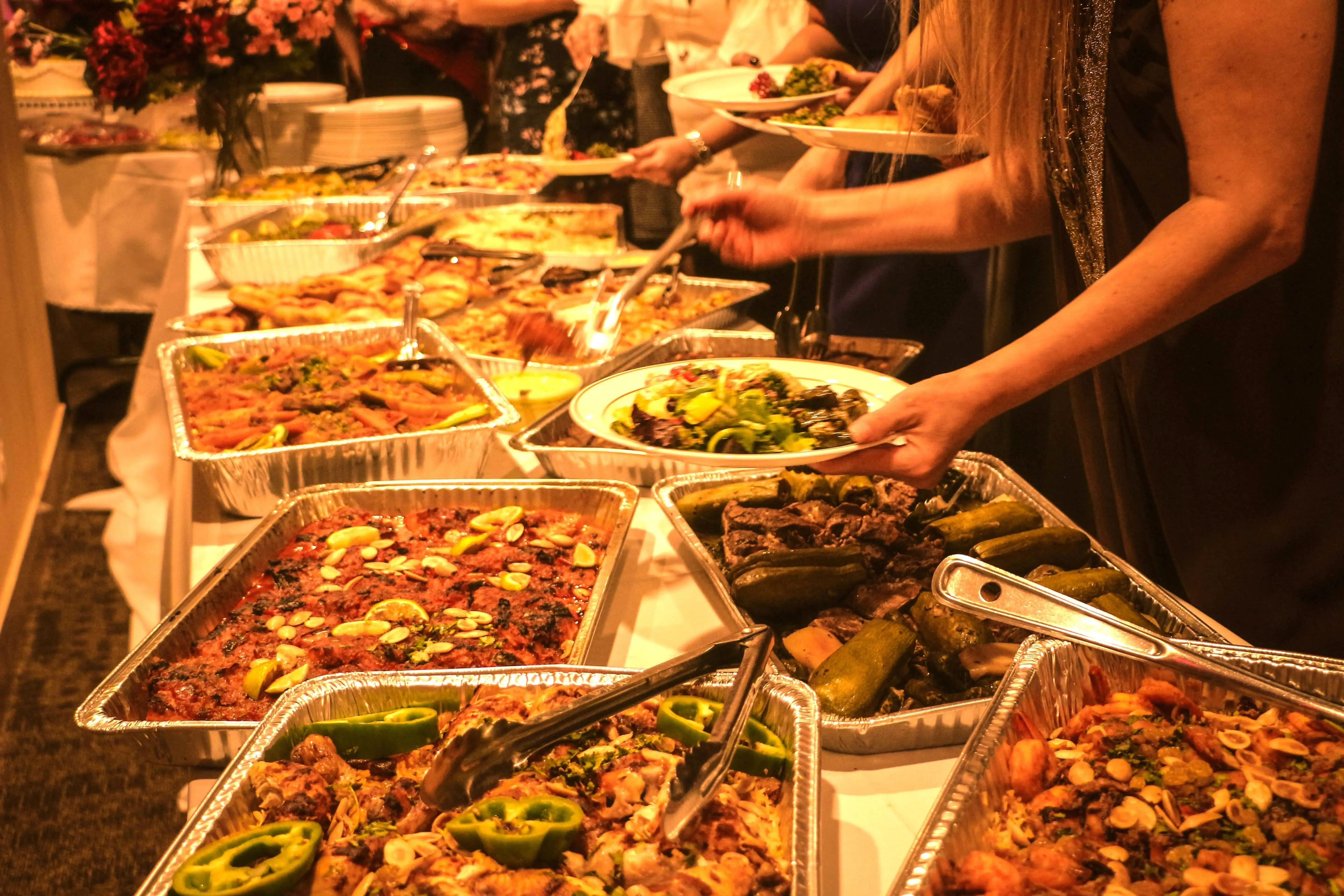
A buffet also feels more substantial than a drop-off lunch. Rows of Green Curry, Cashew Chicken, Pad See Ew, and Pineapple Fried Rice under open lids read as an event, which matters for appreciation lunches, milestone celebrations, and all-hands meetings where the food is part of the message.
Thai food is unusually suited to the format:
- Curries and stir fries hold heat in covered trays through a long serving window.
- Rice and noodles anchor the plate, so a smaller number of mains still feels like a complete meal.
- Mild and spicy live side by side, with Massaman Curry and Cashew Chicken for cautious eaters and Basil Stir Fry or Red Curry for people who want heat.
- Vegetarian dishes are real mains, not sides: Mixed Vegetable Curry, Tofu Basil, and Vegetable Pad Thai carry a plate on their own.
Evergreen Thai Kitchen & Bar has been running buffet-style setups and tray orders for downtown offices since 2007, from 12-person boardrooms to company-wide gatherings in the hundreds. The rest of this guide shows how to decide between formats, what to put on the table, and what moves the price.
Buffet, party trays, or boxed meals: what each format does
Companies often compare buffet catering, party trays, and boxed meals as if one were always better. Each solves a different event problem, and the right choice depends on what the meal needs to do.
- Party trays are the drop-off format: shared trays of a few dishes plus rice, opened on a table, served by the team itself. Best for small, casual, short-window meals with limited setup space.
- Buffet-style catering is party trays at scale, arranged as a serving line with more dishes, more variety, and a clearer flow. Best for medium to large groups where variety and event feel matter.
- Boxed or individual meals are portioned per person and handed out. Best when logistics matter more than atmosphere.
At Evergreen Thai, a “full-service” order is a buffet-style setup with delivery coordination and trays arranged for a serving line. Onsite serving staff are not part of the service, so for very large events the organizer’s team runs the line, and the kitchen plans tray counts and arrival timing to make that easy.
A practical rule:
- Choose trays when simplicity matters most
- Choose a buffet when variety and event feel matter most
- Choose boxed meals when distribution and portion control matter most
The guide to Thai party trays for downtown team events goes deeper on the small-group format; this article focuses on where a buffet earns its place.
Party trays vs individually packaged meals for office lunch
Shared trays and individual meals solve different workflow problems, and downtown offices should choose by workflow. Shared party trays are the better default for most office lunches because they cost less effort per person, cover mixed diets from a few trays, and let people take what they actually want. Individually packaged meals are the better choice in four specific situations:
- The meeting does not stop for lunch. People eat at the table while the agenda continues, and nobody can get up to serve.
- Guests are dispersed. A training day spread across three rooms, or a hybrid team where some people grab lunch and leave.
- Portion control matters. Fixed budgets per head, or a compliance reason to know exactly what each person received.
- There is no setup surface. Some boardrooms and clinics have nowhere to open six trays.
Compare formats on execution outcomes rather than cuisine labels: can it arrive hot in a realistic window, can mixed diets be served without a second vendor, does the setup fit the room, and can one organizer manage it in one thread? Trays win the first two more often; boxes win the last two in tight spaces.
A mixed setup is often the answer in downtown towers: shared trays for the main group plus a handful of labelled boxed meals for people with specific dietary needs or early exits. Evergreen Thai prepares boxed and individual meals on request alongside tray orders, so a single delivery can carry both.
Buffet vs boxed for 20 guests vs 200 guests
The right format shifts with headcount, and the 20-person and 200-person cases show why.
For 20 guests, either format works
A 20-person team lunch is flexible. A buffet or shared trays work better when the group eats together in one room, the event is a relaxed lunch or appreciation meal, and the host wants people to choose. Boxed meals work better when the group is moving through an agenda, timing is tight, and a pickup-and-eat format is simpler than opening trays. At 20, the decision is convenience versus shared experience, and neither answer is wrong.
For 200 guests, the choice becomes strategic
At 200, the format shapes the whole event. A buffet creates the stronger experience because it looks like real hospitality: visual abundance, easy variety, and a plate people build themselves. That makes it the right fit for employee appreciation events, large office celebrations, community events, and campus or association gatherings.
Boxed meals still work at 200, but for different reasons: food must be handed out quickly, seating is limited, guests are spread across floors, or the organizer wants controlled portions. Workshops and staff lunches with strict time windows are the classic case.
Whichever you choose at this scale, plan two serving lines or two handout points, stagger arrival by team, and confirm the room can absorb 200 people moving at once. The guide to catering for 1000 employees walks through the scale ladder from 100 to 1000 and when to contact the kitchen early about capacity.
Build a strong Thai buffet menu
A balanced Thai buffet includes a mix of proteins, a rice or noodle dish, a substantial vegetable option, a starter, jasmine rice, and clear labels for anything vegetarian, vegan, spicy, or containing nuts. Balance matters more than quantity: two curries and a stir fry cover more preferences than three curries.
Buffet for 25 to 30 guests (6 to 7 trays):
- Spring Rolls and Chicken Satay
- Green Curry with chicken
- Cashew Chicken
- Mixed Vegetable Curry (vegetarian anchor, sized for everyone)
- Pad See Ew or Vegetable Pad Thai
- Jasmine rice
- Mango Salad if the room wants something fresh
Buffet for 60 guests (9 to 10 trays): add Massaman Curry, Basil Stir Fry, Tofu Basil, and Pineapple Fried Rice, and double the rice.
Buffet for 150 to 200 guests: repeat the 60-person menu across two identical serving lines rather than adding new dishes. Identical lines move faster and keep replenishment simple.
Three menu rules that hold at every size:
- Size the vegetarian mains above the vegetarian headcount. Meat-eaters take from them too, and running out of the vegetarian tray is the most common buffet complaint.
- Keep one mild curry and one mild stir fry so cautious eaters are never limited to rice.
- Label everything. “Vegetarian”, “Vegan”, “Mild”, “Spicy”, “Contains nuts” on each tray removes the questions that slow a line.
Thai curries at Evergreen use coconut milk, not dairy. Vegetarian and vegan versions of noodle, curry, and rice dishes are available on request, and gluten-aware and no-onion-no-garlic dishes can be prepared; ask when ordering, because fish sauce and oyster sauce are used in the kitchen. The guide to Thai catering for mixed dietary preferences gives tray ratios for half-vegetarian rooms.
What shapes Thai buffet catering pricing
The price of a Thai buffet is driven by scope, not by a fixed per-person rate, and it is more useful for corporate planners to think in terms of service level than price per head. Five things move the number:
- Headcount. More guests means more trays, but the cost per person usually falls as trays are shared across a bigger group.
- Menu complexity. Six trays with two proteins costs less than ten trays with four. Adding variety adds cost faster than adding rice.
- Protein choices. Chicken and tofu dishes sit lower than seafood such as Crispy Calamari.
- Setup requirements. Serving utensils, chafing setups, and a second serving line for large rooms change the scope.
- Delivery distance and timing. Direct group delivery is included for orders over CAD 200 within 5 km of 175 Dundas St W; outer zones and very early windows may need extra coordination.
A cheaper format is not always better value. A tray order that leaves a 60-person appreciation lunch feeling thin costs more in goodwill than the buffet would have. Set the budget band first, then prioritize core mains and rice, and add supporting dishes only once coverage and quantity are sufficient. The guest count and budget guide turns headcounts into tray counts inside a planning range, and the kitchen will size a menu to the budget you name in the quote request.
Set up a buffet in a downtown office
A buffet in a downtown tower succeeds on logistics before it succeeds on food. The friction points are the same everywhere in the core: lobby security, concierge handoff, shared freight elevators, limited loading access, and a lunch window from 11:45 a.m. to 1:00 p.m. that does not move.
Use one planning flow for every buffet order:
- Confirm the headcount range and attendance risk.
- Consolidate dietary notes in one message.
- Decide the format: shared trays, buffet-style line, or trays plus boxed add-ons.
- Validate building details: entrance, floor, handoff contact, backup phone.
- Confirm the room-ready time and the setup surface.
- Keep one owner responsible for day-of communication.
For the room itself:
- Two tables in an L or a single long table for up to 60; two parallel lines above 100
- Rice and the vegetarian anchor at the start of the line so plates fill in the right order
- Plates, utensils, napkins, and serving spoons out before the food arrives
- Delivery 20 to 30 minutes before service so lids stay on until the break
- A short debrief afterwards: on-time room readiness, dietary fit, leftovers versus attendance, and whether labelling and flow worked
Scenario emphasis differs: a boardroom lunch prioritizes exact room-ready time and a clean setup, a workshop prioritizes easy self-serve flow and portion stability, a hybrid anchor day prioritizes mixed preferences and a fast reset, and a campus or condo event prioritizes handoff clarity. All of them benefit from confirming logistics early.
Choose by team size and event goal
There is no single best choice between a buffet, party trays, and boxed meals; the best choice is the one that fits the headcount, the space, the timing, and the experience the company wants. Four questions settle most decisions:
- Is this a meeting meal or an event meal? Meeting meals lean to trays or boxes; event meals lean to a buffet.
- Are guests eating together or separately? Together favours a buffet; dispersed favours boxes.
- Is speed more important than experience? Speed favours boxes; experience favours a buffet.
- Is the group closer to 20 or closer to 200? Small groups are fine with trays; large groups gain the most from a buffet line.
By team size, the pattern is consistent. For fewer than 25 people, party trays are usually ideal. For 25 to 100, a buffet provides the best balance of variety and effort. For groups in the hundreds, execution matters most: the risk of delay, congestion, and messy setup rises quickly, so a buffet with two lines and staggered arrival, or boxed meals with multiple handout points, is the safer plan.
Thai food adapts across all three formats without changing cuisine as the team grows, which is why many downtown offices settle on one kitchen for the 12-person lunch and the 300-person town hall alike.
Order a Thai buffet from Evergreen Thai
Evergreen Thai Kitchen & Bar cooks at 175 Dundas St W, at University Avenue, a few minutes from City Hall, the Financial District, the hospital row on University Avenue, TMU, and UofT. The short route is why a buffet arrives hot and why a 30-minute setup buffer is realistic. Buffet-style setups, party trays, and boxed meals on request all come from the same kitchen, comfortable from 10 guests to 500 and beyond; for 500 to 1000, contact the kitchen early to confirm capacity and timing.
The catering hub explains formats and the request process. When you are ready, send the date, headcount range, building details, dietary notes, and budget range, then get a catering quote or call +1 416-581-8668 and the kitchen will size a buffet menu to your room.