What vegetarian-friendly catering really means for a downtown group
Vegetarian-friendly catering means vegetarian guests get a complete meal, not a side dish and a label. In practice that is at least one substantial vegetarian main, a shared starch, and an appetizer they can eat without asking, sized for the whole table rather than the three people who ticked “vegetarian” on the form.
Most office catering in Toronto still treats vegetarian coverage as a backup tray. The result is predictable: the vegetarian tray disappears first because meat-eaters take some too, and the vegetarian guests end up with rice and Spring Rolls. Evergreen Thai Kitchen & Bar at 175 Dundas St W has catered downtown offices since 2007, and the orders that work share a few traits:
- Vegetarian mains are headline dishes, such as Green Curry with tofu or Vegetable Pad Thai, not a small side of steamed vegetables.
- Volume reflects crossover demand. Non-vegetarian guests share vegetarian dishes, so a vegetarian tray sized only to strict vegetarian headcount runs out.
- Vegetarian and vegan are separate planning buckets. A vegetarian tray with egg is not vegan-safe, and a vegan tray is not automatically nut-free.
- Ingredient notes are explicit, so the office admin can approve the order without a second round of questions.
Treat “vegetarian-friendly” as an operational promise about volume, labelling, and preparation. If a caterer can only say “vegetarian options available”, ask what those options are, how big the trays are, and whether they contain egg or fish sauce. The answers tell you more than the label does.
Vegetarian vs vegan vs plant-based: what to say when ordering
The three labels mean different things, and “vegetarian” in particular means different things to different diners. Naming what a guest does and does not eat is more reliable than the label alone.
- Vegetarian usually excludes meat and seafood but allows dairy, eggs, and honey. The hidden issue in Thai and Chinese cooking is fish sauce, oyster sauce, and shrimp paste, which can appear in vegetable dishes that look meat-free.
- Vegan excludes every animal-derived ingredient: meat, seafood, dairy, eggs, honey, gelatin, and the same fish and oyster sauces.
- Plant-based is the least standardized term. Some diners mean strict vegan, others mean mostly plants with occasional dairy or eggs.
What to tell the kitchen, word for word:
- Vegetarian: “Vegetarian, no meat or seafood. Please confirm no fish sauce or oyster sauce.”
- Vegan: “Vegan. No meat, seafood, dairy, eggs, or honey. Please confirm no fish sauce, oyster sauce, or shrimp paste.”
- Plant-based: say exactly what the guest eats, for example “plant-based, no dairy or eggs, honey is fine”.
- Religious practice: add the specific rule, such as no onion and no garlic or no egg, as a separate line.
At Evergreen Thai, fish sauce and oyster sauce are in the kitchen, so vegan versions of noodle, curry, and rice dishes are prepared on request and must be stated when ordering. The curries use coconut milk rather than dairy, which is why Thai curry is usually a dairy-free choice, but that does not make every curry vegan until the sauce base is confirmed. State the requirement at order time, not when the trays arrive.
How to read a catering menu: egg, dairy, nut, and fish sauce notes
A catering menu is only as useful as its ingredient notes, so build a simple legend before you compare dishes. Use six flags in your intake sheet and your order email: V (vegetarian), VG (vegan), egg, dairy, nuts, and spicy.
Apply the flags to a Thai menu like this:
- Egg: Pad Thai and fried rice are traditionally cooked with egg. Ask for no egg for vegan guests and for vegetarians who avoid it.
- Dairy: Thai curries and Tom Kha soup use coconut milk, not cream. Dairy shows up rarely in the savoury dishes, so this flag is usually clear.
- Nuts: Pad Thai is finished with crushed peanuts, Massaman Curry contains peanuts, and Cashew Chicken is named for its cashews. Nut-sensitive teams should ask when ordering and keep these trays clearly labelled.
- Fish sauce and oyster sauce: these are the default seasoning in many stir-fries and noodle dishes. Vegetarian and vegan trays need this confirmed as a substitution.
- Gluten: soy sauce and some noodle dishes contain wheat. Rice noodle dishes and curries are usually the better fit for gluten-aware guests; treat this as gluten-aware, not certified gluten-free.
Two rules keep this honest. First, treat “vegetarian-friendly” and “vegan-safe” as separate columns; a dish can be one without being the other. Second, ask for practical ingredient notes before approval rather than a certification. Evergreen Thai can describe how a dish is prepared and what is left out on request, but no shared kitchen can promise an allergen-free tray, so ask for preparation notes instead of a guarantee.
Build a vegetarian office lunch that feels like a full meal
A good vegetarian office lunch is warm, protein-forward, and varied enough that vegetarian, vegan, and meat-eating colleagues all feel looked after. Cold sandwich trays and salad boxes fail on exactly those three points, which is why downtown teams near Eaton Centre, City Hall, and University Avenue switch to Thai once they try it.
The checklist for a strong vegetarian lunch:
- one warm main, not only cold items
- real protein from tofu, mushrooms, or legumes
- at least two flavour styles so the table has variety
- a shared starch, usually jasmine rice or noodles, that almost everyone can eat
- clear labels for vegetarian, vegan, mild, spicy, and contains nuts
- an optional meat dish for mixed teams
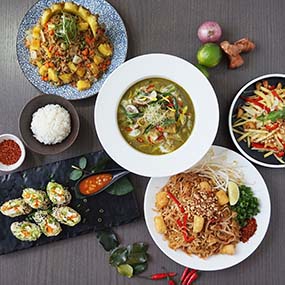
From the Evergreen Thai menu, the vegetarian picks that travel well in trays and hold heat through a 30 to 45 minute lunch window are:
- Green Curry, Red Curry, or Mixed Vegetable Curry with tofu over jasmine rice
- Vegetable Pad Thai, with the sauce confirmed for strict vegans
- Tofu Basil or Basil Stir Fry with vegetables
- Vegetable Pad See Ew or Drunken Noodles with tofu
- Pineapple Fried Rice or Vegetable Fried Rice as a second starch
- Spring Rolls and Golden Tofu as appetizers
- mild Tom Kha soup as a starter in colder months
Spice can be adjusted across the order so the same lunch serves heat-lovers and mild eaters. For a deeper list of hearty options, including mushroom-based dishes and cold-weather comfort picks, see vegetarian catering ideas that are not just salad.
Structure a mixed-team order without two separate menus
The mistake to avoid is building two completely separate menus, which doubles cost and slows the buffet line. A mixed-team order works best when roughly half the dishes are shared and the rest are diet-specific; a 50/50 to 60/40 split between shared and dietary-specific trays covers most downtown offices.
Use a role-based structure:
- Anchor trays: one or two vegetarian mains with real volume.
- Bridge trays: a noodle or rice dish that vegetarian and non-vegetarian guests both share.
- One non-vegetarian crowd-pleaser, such as Chicken Satay or Cashew Chicken, for guests who want it.
- A lighter side, such as Mango Salad, to balance the table.
- A starch anchor of jasmine rice for flexible plating.
A sample lunch for 20 people looks like this: one large tray Vegetable Pad Thai with tofu (shared), one large tray Green Curry with tofu and rice (vegetarian anchor), one tray Tofu Basil (vegan layer, confirmed when ordering), one tray Basil Stir Fry with chicken (optional meat layer), one tray Spring Rolls, and jasmine rice as the base.
For groups that want a fully vegetarian Chinese layer alongside the Thai trays, Vegedelight, the fully vegetarian sister restaurant next door on Dundas, adds vegetable stir-fries, tofu and mushroom dishes, and dumplings on one coordinated delivery. The full ratios for half-vegetarian, half-chicken groups are in the guide to Thai catering for mixed dietary preferences.
How much to order and how far ahead
Plan roughly 700 g, about 1.5 lb, of food per person across appetizers, mains, rice, and noodles combined, and size vegetarian trays to the whole table rather than the vegetarian headcount. Increase slightly when the meeting runs through lunch or the team is active.
Lead times for downtown Toronto:
- Book 24 to 72 hours ahead for most office lunches of 10 to 30 people.
- Allow 5 to 7 days for 40 or more guests, or when the order includes vegan, no-onion-no-garlic, or allergy notes.
- Schedule arrival 15 to 20 minutes before the lunch window; lobby security, concierge handoff, and elevators in tall buildings take longer than expected.
- Reconfirm dietary details the day before, not on delivery day.
Orders over CAD 200 within 5 km of 175 Dundas St W qualify for direct group delivery, which covers the Financial District, the hospital row on University Ave, TMU, UofT, and City Hall. Anything serving 10 or more people should go through the catering quote path rather than a standard delivery app. Tray counts per 10, 20, 30, and 50 guests, and planning bands around CAD 300, 500, and 800 for vegetarian orders, are laid out in the guest count and budget catering guide.
Vegetarian catering for corporate events, training days, and campus groups
Match the vegetarian menu to the purpose of the event, because a training day and a holiday party need different things. Vegetarian-forward catering feels premium and inclusive when it is planned as a system rather than an add-on.
- Training days and workshops need low-friction self-service: two anchors, one bridge noodle, rice, and menu cards so people serve themselves without crowding.
- Holiday and appreciation events need abundance and variety: three or four vegetarian mains alongside meat trays, plus appetizers.
- Campus clubs and student groups near TMU and UofT need budget discipline and easy serving: fewer, larger trays, and party trays instead of boxed meals.
- Hospital and clinic staff meals need staggered timing and dishes that hold; curries and rice do better than fried items over a long window.
- Recurring lunch programs need rotation, so the vegetarian anchor changes weekly between curry, noodle, and stir-fry.
Across all of these, keep vegetarian mains as equal-status headline dishes, keep one familiar flavour profile for broad comfort, and avoid too many single-use dishes that increase waste. Visible labelling matters more as headcount grows; at 50 or more guests, a card on every tray is the difference between a smooth line and a queue of questions.
What to ask before you submit a vegetarian catering order
Ask the planning questions before you submit the order, not on delivery day. The fastest way to avoid problems is one consolidated message that covers headcount, diets, format, and access.
Collect from the team, 2 to 3 days ahead:
- vegetarian count and vegan count, listed separately
- allergies (nuts, shellfish, soy, gluten) listed separately from preferences
- no-onion-no-garlic or other religious or cultural needs
- spice comfort: mild, medium, or spicy
- hard exclusions, meaning anything a guest will not eat
Confirm with the kitchen:
- Are the trays plated service-style or tray-sharing? Match the room format.
- Which vegetarian dishes contain egg, nuts, or fish sauce as prepared, and which can be adjusted?
- Building access, concierge handoff, floor, room, and a backup phone number.
- Whether utensils, labels, dessert, and drinks come with the order or from the venue.
- Budget, so the recommendation is scoped correctly.
Give the final attendee band, not just the invited count, and put the diet breakdown in numbers, for example 12 meat, 5 vegetarian, 3 vegan. The full delivery-notes template lives in the office catering checklist for downtown Toronto office managers.
Why Evergreen Thai for vegetarian catering downtown
Evergreen Thai Kitchen & Bar has cooked for downtown Toronto teams since 2007, from a kitchen at 175 Dundas St W that sits steps from St Patrick station, City Hall, and the Eaton Centre. That location means short routes to the Financial District, the hospitals on University Ave, TMU, and UofT, and food that arrives hot.
Vegetarian is not an afterthought here. Vegetarian and vegan versions of the noodle, curry, and rice dishes are available on request, the curries are built on coconut milk, and selected dried mushrooms come through Ontario supplier Fungi Origin for the tofu and mushroom dishes. Vegedelight next door adds a fully vegetarian Chinese and Thai menu when a group wants a bigger meat-free spread. Party trays, buffet-style setups, and boxed meals on request cover 10 to 500+ guests.
Send headcount, the vegetarian and vegan split, timing, and the building details, and the kitchen will size the trays. Get a catering quote or call +1 416-581-8668 to plan a vegetarian office lunch that feeds the whole team from one order.