What makes corporate catering in downtown Toronto different
Corporate catering in Toronto succeeds or fails on execution, not on menu photos. In the core, a kitchen has to move hot food through traffic, past a concierge desk, up a freight elevator, and into a boardroom that was booked for exactly 12:00. A caterer that performs well at a suburban backyard party can struggle with a King and Bay tower on a Tuesday.
The friction points repeat across the core:
- Lobby security and concierge handoff. Many towers will not let a driver upstairs without a pre-registered contact.
- Elevator wait times. Freight elevators are shared with couriers and movers at midday.
- Limited loading access. Some buildings have no stopping zone on the street side at all.
- Narrow lunch windows. Most downtown lunches run from 11:45 a.m. to 1:00 p.m., and the meeting does not wait.
When these are ignored, even an excellent menu underperforms: food sits in a lobby, the room is not ready, and the organizer spends the meal on the phone. When they are planned early, the meal is simply there when people walk in. Every section below is built around that idea. Format, headcount, neighbourhood, and menu all follow from one question: how does the food get from the kitchen to the room on time?
Regular delivery, group order, or catering: pick the right path
Not every group meal needs a catering request, and not every large order should be pushed through an app. The right path depends on coordination load, not just cost. A useful question is not “how many people is this for” but “how many things can go wrong if this stays in a normal delivery flow”.
- Regular delivery (Uber Eats, DoorDash, Fantuan) fits small, flexible orders where nobody needs help: a few desks, no fixed start time, no building handoff.
- Direct group order fits mid-sized teams that want one coordinated drop. Evergreen Thai delivers group orders over CAD 200 directly within 5 km of 175 Dundas St W, which covers most of the core. The group order page for downtown Toronto explains how that works.
- Catering fits any meal for 10 or more people where timing is fixed, the building has access rules, dietary needs must be balanced, or the room needs setup. At that point the organizer benefits from confirming details with a person instead of a checkout screen.
Move to the catering path sooner rather than later when the meal is time-sensitive, when the guest list keeps changing, or when the order involves more than a couple of trays. That is usually the difference between an easy group meal and a stressful one.
Which office events usually need catering
Most corporate catering in the core falls into a handful of event types, and each one changes what you should prioritize.
- Boardroom and client lunches: exact room-ready time and a clean, shared setup matter most. Portions should look composed, not piled.
- All-hands and town halls: volume and flow. Food has to serve a crowd in minutes without a queue that eats the meeting.
- Training days, workshops, and onboarding: easy self-serve flow and portion stability across a long day, often with a mid-afternoon reset.
- Hybrid anchor days: mixed preferences and headcount uncertainty, since attendance on in-office days swings.
- Employee appreciation and celebrations: presentation and variety. A buffet with a few standout dishes does more than extra trays of the same thing. The employee appreciation catering guide covers menus for those weeks.
- Holiday parties and year-end events: book earliest of all, because December slots go fast.
- Campus, clinic, and condo events: handoff clarity and practical tray formats, because there is rarely a loading dock or a reception desk.
A leadership off-site and a Friday team lunch can have the same headcount and need completely different service. Name the event type in your request and the kitchen can suggest the right format before you pick dishes.
Choose the format by headcount: 10 to 1000 guests
The best catering format changes as the group grows, and using the same setup for every occasion is the most common mistake downtown teams make.
- 10 to 25 people: keep it simple. Party trays with jasmine rice, one or two mains, and a starter feed a small team without turning lunch into a setup project. Speed and convenience win here.
- 25 to 100 people: buffet-style service is usually the sweet spot. It gives more variety, feels like an event, handles mixed diets well, and avoids managing dozens of individual meals.
- 100 to 500 people: logistics start to dominate. Delivery timing, serving lines, table layout, and replenishment shape the experience more than any single dish. Plan two serving lines and stagger the room if you can.
- 500 to 1000 people: contact the kitchen early to confirm capacity and timing. Staged deliveries, multiple lines, and a clear floor plan need to be worked out from the start. The guide to catering for 1000 employees walks through the scale ladder.
Boxed or individual meals are available on request and make sense when people eat at their desks or leave the room at different times. Evergreen Thai Kitchen & Bar is comfortable from 10 guests to 500 and beyond; the ranges above are planning starting points, and the kitchen will turn a headcount and budget band into an actual tray count when you ask for a quote.
Why Thai food works for corporate catering
Thai food is one of the strongest cuisines for office groups because it feels like an upgrade without making service harder. Many downtown teams are tired of the same sandwich and pizza rotation, and a Thai spread reads as interesting while staying recognizable to almost everyone.
Three practical reasons it works:
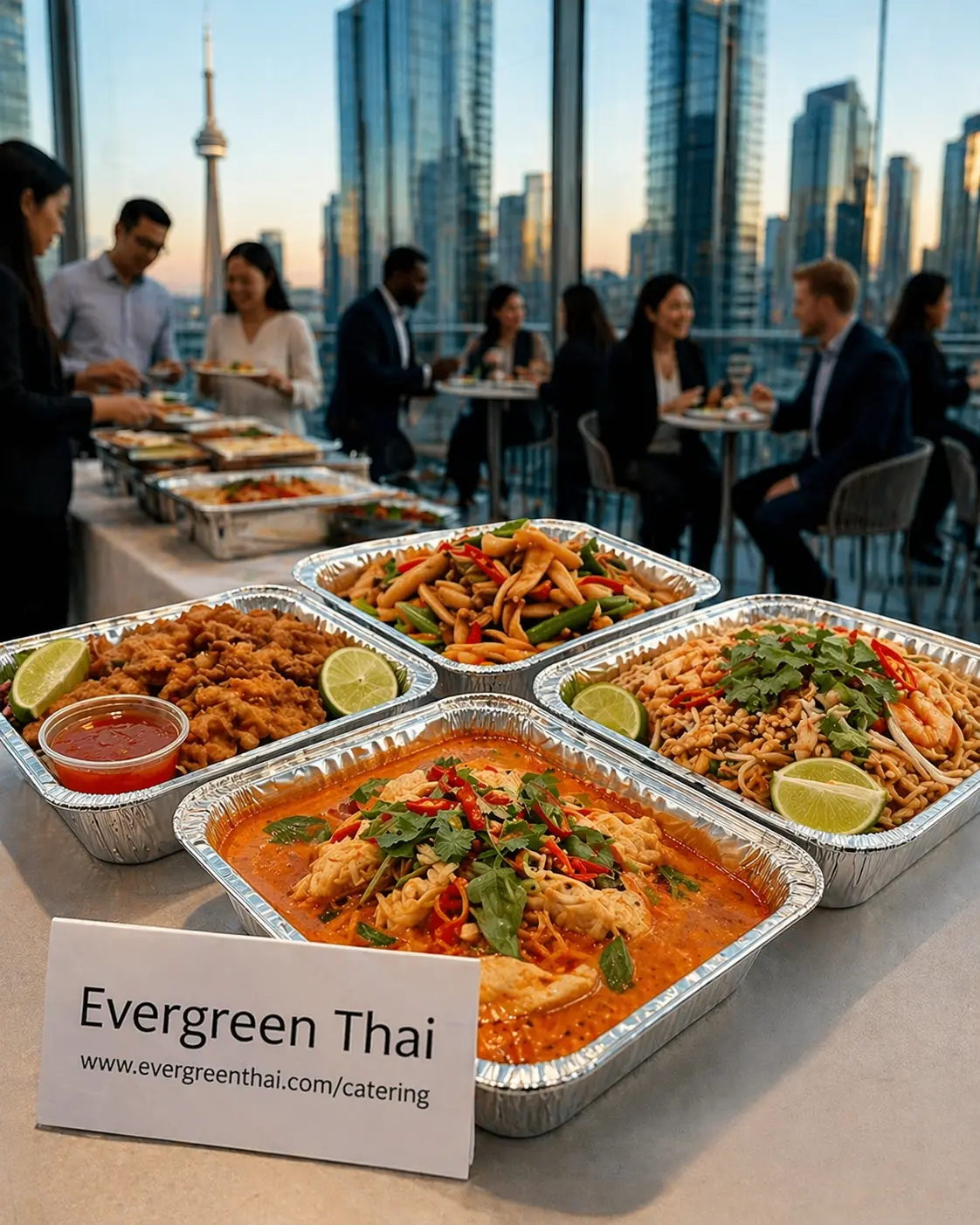
- It fits every format. Curries, stir fries, fried rice, and noodles hold heat in trays, serve cleanly from a buffet line, and portion neatly into boxes.
- It covers mixed diets from one kitchen. Diverse Toronto teams respond to range. Green Curry, Massaman Curry, Cashew Chicken, and Basil Stir Fry sit next to Vegetable Pad Thai, Tofu Basil, Mixed Vegetable Curry, and Vegetable Fried Rice, so vegetarians are not handed a side salad. Thai curries at Evergreen use coconut milk, not dairy, and vegan versions of noodle, curry, and rice dishes are available on request. State vegan needs when ordering, since fish sauce and oyster sauce are used in the kitchen.
- Crowd-pleasers are built in. Spring Rolls, Chicken Satay, Golden Tofu, Pad Thai, and Pineapple Fried Rice need no explanation on a label.
For mixed groups, build the order with role-based trays rather than ad-hoc substitutions: an anchor tray (a substantial vegetarian main with real volume), bridge trays everyone shares (Pad Thai, fried rice, a mild curry), and one protein tray for broader coverage. Size the vegetarian trays above the vegetarian headcount, because meat-eaters take from them too. The guide to Thai catering for mixed dietary preferences gives the ratios.
Restaurant caterer, catering company, or out-of-area vendor: how to compare
For downtown offices, a restaurant kitchen that is already downtown is the better choice for most weekday meals, and the reason is operational rather than culinary. Compare options on execution outcomes, not cuisine labels:
- Can it arrive hot in a realistic window?
- Can mixed diets be served without splitting the order across two vendors?
- Will the setup work in your room layout?
- Can one organizer coordinate everything in one thread?
Restaurant catering vs corporate catering companies. Dedicated event companies shine at formal functions with rentals, staffing, and full service. For a recurring team lunch, a boardroom meal, or an appreciation buffet, a restaurant kitchen gives you a menu people already know, direct contact with the people cooking, and simpler pricing. Evergreen Thai does not provide onsite serving staff, so if a fully staffed formal dinner is the brief, say so early and plan the room with your own team.
Downtown restaurant vs out-of-area caterer. The strongest downtown positioning is not “we can deliver to downtown” but “we are already downtown”. Shorter routes mean food is cooked closer to service time, holds temperature better, faces less traffic risk, and can be adjusted when a meeting shifts. That chain, downtown kitchen to shorter route to hotter food to better lunch, is more persuasive than any “fresh ingredients” claim.
Checklist for choosing any caterer: menu flexibility, honest dietary handling, realistic delivery windows, experience with your building type, and a straight answer on whether they have handled your scale before. Reliability, communication, and timing protect the event on the day. Menu photos do not.
Neighbourhoods and delivery radius
The 5 km rule is the single most useful planning fact. Evergreen Thai’s direct group delivery applies to orders over CAD 200 within 5 km of 175 Dundas St W, and that circle covers almost all of downtown Toronto. Larger catering orders use the same geography. The downtown Toronto corporate catering page has the request details.
Typical reach from the kitchen at Dundas and University, as planning estimates rather than promises:
- Eaton Centre, Yonge-Dundas, City Hall, Nathan Phillips Square: under 1 km, 10 to 15 minutes
- Financial District and the Bay Street corridor: about 1.5 km, 12 to 18 minutes. PATH-connected towers need a pre-registered contact, and the Financial District catering guide has tower-by-tower notes
- King West and King-Spadina: about 2 km, 15 to 20 minutes
- Yorkville and Bloor-Yonge: about 2 km, 12 to 18 minutes
- Harbourfront, CN Tower, South Core: about 2 km, 15 to 20 minutes
- Distillery District and St. Lawrence Market: about 2.5 km, 18 to 22 minutes
- The Annex and UofT St. George: about 2.5 km, 15 to 20 minutes
- Liberty Village: about 3 km, 20 to 25 minutes
- Riverdale and the Leslieville edge: about 4 km, at the edge of the radius
Traffic and building access decide the rest. For outer-edge zones, schedule delivery 25 to 30 minutes before the lunch window instead of 15 to 20, and favour dishes that hold heat, such as curries, stir fries, and rice or noodle bases, over anything that depends on crispness.
Bloor and Bay, Yorkville
Catering north of the core has a slightly different tone. Requests come from professional offices at Bloor and Bay, Yorkville retail teams, medical and wellness clinics, condo party rooms, client lunches, and small corporate events that need food to feel polished without becoming hard to coordinate. Keep the menu complete but not overloaded: one broad-appeal main, one vegetarian-friendly dish, rice or noodles, and a starter. Confirm the entrance, parking or lobby constraints, receiver phone, and room-ready time, since many Yorkville buildings have no loading area.
Lead times across the radius
- 10 to 25 people: 24 to 72 hours ahead
- 30 to 50 people: 3 to 5 days ahead
- 60 or more: 5 to 7 days ahead, and two weeks in December or peak conference season
- Recurring weekly orders: a standing order locks in dishes, dietary headcount, and a delivery slot; adjust with 48 to 72 hours of notice
Plan the order: a framework you can reuse
One standardized planning flow prevents most preventable downtown failures. Use it for every order, whether it is 12 people in a boardroom or 300 at an all-hands.
- Confirm the headcount range and attendance risk. Plan for the realistic number, not the invite list.
- Consolidate dietary notes in one message. Vegetarian, vegan, dairy-free, gluten-aware, and no-onion-no-garlic requests are available on request; confirm them when ordering rather than assuming.
- Decide the service format: shared trays, buffet-style setup, or boxed meals as an add-on.
- Validate building details. Building name and full address, company name and floor or suite, primary and backup contact, preferred handoff point (lobby, concierge, reception, or the room), and target in-room readiness time. In larger towers, delay usually comes from handoff ambiguity, not kitchen timing.
- Confirm the room-ready time and setup surface. A buffet needs a table; a boardroom needs the trays to arrive before the client does.
- Keep one owner responsible for day-of communication, with a phone that will be answered.
The office catering checklist for downtown Toronto expands each step into a copy-and-paste request.
After the meal, capture a 2-minute debrief: was the room ready on time, did the dietary coverage feel right, how much was left relative to attendance, and did labelling and serving flow work. That record makes the next order faster and makes recurring lunches better every month.
Why downtown teams book Evergreen Thai, and how to start
Evergreen Thai Kitchen & Bar has been cooking at 175 Dundas St W, at University Avenue, since 2007. That is 19 years of weekday lunches for offices around City Hall, the Financial District, the hospital row on University Avenue, TMU, and UofT, and it is why the kitchen understands freight elevators and 12:00 meetings as well as it understands Green Curry.
What teams get:
- A central kitchen steps from St Patrick station, with direct group delivery for orders over CAD 200 within 5 km
- Formats that scale: party trays, buffet-style setups, and boxed meals on request, from 10 guests to 500 and beyond
- Honest dietary handling: vegetarian, vegan, dairy-free, gluten-aware, and no-onion-no-garlic dishes available on request and confirmed at order time
- A vegetarian sister restaurant next door. Vegedelight, fully vegetarian Chinese and Thai, sits beside the kitchen on Dundas, so a plant-based layer can travel in the same drop
- Group dine-in at the restaurant for teams that would rather walk over, Monday to Saturday 11am to 9pm and Sunday 3pm to 9pm
To start, send the event type, date, headcount range, building details, dietary notes, and budget range, and the kitchen will come back with a menu and timing that fits. Get a catering quote, or call +1 416-581-8668 to talk it through.