Think in flow, not food
The biggest mistake in 1000-person catering is treating it like a larger version of a normal lunch. At 20 people the menu is the plan. At 1000, Thai buffet catering in Toronto succeeds or fails on traffic flow, station count, replenishment, and timing, and the menu is chosen to serve those constraints rather than the other way around.
Four questions decide the shape of any large event before a single dish is named:
- Will everyone eat at once, or will departments rotate through a serving window?
- Where does the food go: lunchroom, open office floor, meeting space, or several floors?
- How long can one station take to serve one guest without the line becoming the event?
- Is this a simple drop-off with the organizer’s team laying out trays, or a buffet-style setup with multiple lines?
Large events also expose downtown constraints that a small order hides: security desks, concierge handoff, one freight elevator for a 40-storey tower, and a lunch window that runs from 11:45 a.m. to 1:00 p.m. whether or not the food is upstairs. A kitchen at Dundas and University reaches most downtown addresses on a short route, which is worth more at scale than at 20 covers, because a late arrival for 1000 people cannot be absorbed.
Once flow is settled, the guest experience can stay simple while the operations behind it get stronger. That is the whole approach: keep the front of house calm by doing the work in the plan.
The scale ladder: 100, 200, 500, and 1000
Each step up the ladder changes what breaks first, so plan for the step rather than the total.
100 people: coordinate it like an event, not a delivery
A 100-person office lunch usually breaks for operational reasons, not food reasons: someone forgets to confirm real headcount, the building has delivery restrictions, or the order is placed too late for a clean handoff. Lock timing, access, dietary needs, and serving style before debating dishes:
- decide buffet-style, tray service, or individual portions
- check lobby, freight elevator, and concierge requirements in advance
- give the kitchen a realistic delivery window, not a guess
- balance the menu across rice trays, noodle trays, chicken and beef or seafood options, vegetarian mains that feel like mains, and starters to share
200 people: the threshold where direct coordination pays off
Evergreen Thai delivers group orders over CAD 200 directly within 5 km of 175 Dundas St W, and any order serving 10 or more people should come through the catering quote path rather than app checkout. At 200 guests that threshold is about practicality: packaging, timing, and handoff matter more than they do for a normal delivery, and a quick direct check-in confirms date, service type, and building notes. This is also where one serving line starts causing delays, so plan duplicate stations, separate labelled vegetarian and vegan trays, and serving windows by department.
500 people: an operations project that feels casual to guests
Five hundred is the comfortable upper end of a single kitchen order. Behind the scenes it needs structure: where staff queue, how many guests one station serves per minute, how multiple floors are handled, and who manages plates, waste, and replenishment. Organizers should plan for their own volunteers or the venue’s staff to keep lines moving; that role should be assigned, not assumed.
1000 people: confirm capacity early and build on repetition
For 500 to 1000 guests, contact the kitchen early to confirm capacity and timing. Events at this size run on repetition: multiple food stations with identical menus, mirrored serving lines so two groups move at once, staggered windows by department, and a delivery plan that brings trays in waves rather than all at once. The menu should be shorter than at 100, not longer.
Design the buffet layout for throughput
A good menu fails if everyone is forced through one narrow serving point. Layout is the difference between a 15-minute meal and a 50-minute queue at 500 or more guests.
Layout rules that hold at every large size:
- Mirror the stations. Two identical lines serving from both sides of a table double throughput without doubling dishes.
- Put rice and noodles first, curries and stir-fries second, starters and salad last. Guests build a plate in one pass and do not double back.
- Sign every tray. Dish name, main protein, and a vegetarian or vegan marker where it applies. Signage answers the questions that otherwise stall the line.
- Separate the dietary station. A clearly labelled vegetarian and vegan section, replenished on its own schedule, stops those trays emptying first as everyone helps themselves.
- Plan replenishment before the first guest. Assign someone to watch tray levels and bring backups from a holding area so the line never sees an empty pan.
- Keep a service window per group. Departments arriving at 12:00, 12:20, and 12:40 spread the load; an all-at-once call creates the crush.
Space matters as much as sequence. A buffet in a hallway backs up at the corners; the same trays in a lunchroom or open floor with two exits move steadily. Walk the room before ordering and confirm where trays, plates, and waste will sit, then send those details with the order so the drop-off lands where the layout needs it.
Choose dishes that hold, portion cleanly, and appeal broadly
Large events need dishes that stay good on a buffet for an hour, serve with a spoon in one motion, and appeal to a room where a third of people are spice-cautious. That does not mean boring food; it means choosing from the parts of the Thai menu built for volume.
A structure that works from 100 to 1000, replicated across stations:
- One or two broad-appeal mains: Cashew Chicken, Basil Stir Fry, Green Curry, Massaman Curry
- One substantial vegetarian main: Tofu Basil, Mixed Vegetable Curry, Golden Tofu
- One or two base trays: Pad Thai, Pad See Ew, Pineapple Fried Rice, jasmine rice
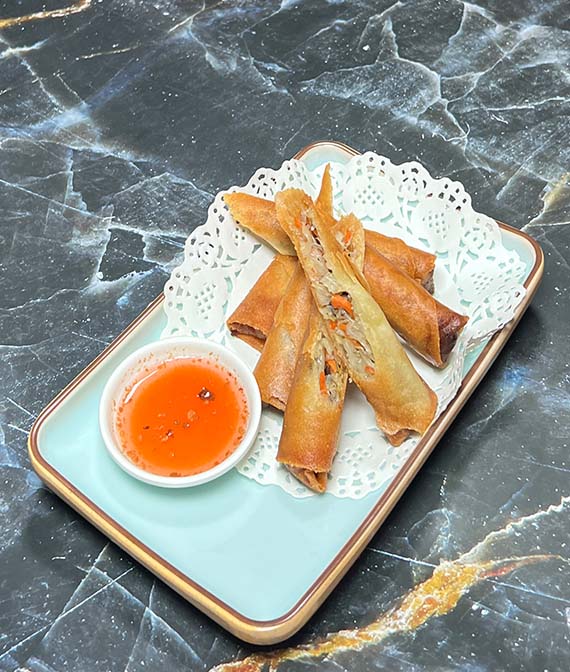
- One balancing side: Spring Rolls, Chicken Satay, Mango Salad
Curries hold best and stretch furthest over rice, which is why they anchor most large Thai buffets. Stir-fries and fried rice hold well too. Crispy Calamari is a strong starter at 50 but loses texture across a long service, so keep it for smaller rooms or a first-wave tray.
Keep spice mild to medium on shared trays and offer chili on the side. Thai curries at Evergreen Thai use coconut milk, not dairy, which resolves a common question at scale. Vegetarian and vegan versions of the noodle, curry, and rice dishes are available on request; vegan requests must be stated when ordering because fish sauce and oyster sauce are used in the kitchen. Gluten-aware and other needs are handled on request and confirmed at order time, with no claim of certified allergen-free preparation.
All-hands meetings and recurring company meals
All-hands catering should optimize for speed, inclusivity, and low-friction service, because the meal is the pause between the leadership slides and the Q&A, not the event itself. Use one standardized flow every time so the order never has to be rebuilt:
- Confirm the headcount range and attendance risk.
- Consolidate dietary notes in one message.
- Decide the service format: shared trays, a buffet-style setup, or packaged add-ons for hybrid staff leaving early.
- Validate building details: entrance, floor, handoff contact, backup phone.
- Confirm room-ready time and the setup surface.
- Keep one owner responsible for day-of communication.
For monthly or weekly all-hands, set a baseline structure and rotate one or two components per cycle so variety stays high without new planning each time:
- Week 1: noodle-forward mix (Pad Thai, Pad See Ew, one curry)
- Week 2: rice and curry mix (Green and Massaman Curry, Pineapple Fried Rice)
- Week 3: stir-fry and lighter sides (Basil Stir Fry, Golden Tofu, Mango Salad)
- Week 4: team favourites with one seasonal swap
After each order, run a short debrief: on-time room readiness, dietary fit confidence, leftover ratio against attendance, and comments on labels and flow. That baseline makes the next order faster, and it is the same rotation logic behind the weekly programs in the office lunch catering downtown Toronto guide.
Conferences, training days, and workshops
Training-day food has to support focus and schedule discipline, so align delivery to the session break rather than a generic lunch window. A facilitator who planned a 12:15 break needs trays in the room at 12:05, not a driver in the lobby at 12:30.
Principles that keep the room on schedule:
- Match the menu to the purpose. Training days need low-friction self-service; conferences with mixed external guests need clearer labels and milder defaults.
- Avoid the afternoon crash. Balance heavier noodle and rice trays with Tom Yum or Tom Kha soup, Mango Salad, and a vegetable main, so the 2:00 p.m. session is not lost to a room full of people who ate three plates of Pad Thai.
- Make vegetarian dishes headline options. In workshop groups, non-vegetarian guests share the vegetable curry freely, so size it to the whole room, not the vegetarian headcount.
- Keep labels visible. Self-service with a dozen people reading tray cards at once needs large, simple signage.
- Respect seasonality. Winter programs lean toward curries and soups; summer programs run lighter with salad, stir-fries, and rice.
For multi-day programs, treat the food as a repeatable schedule: a standing dietary profile for the cohort, a controlled rotation, and one owner for the whole run. The ordering language for vegan, vegetarian, and plant-based requests is covered in the vegetarian catering guide for downtown Toronto.
Onboarding days and new-hire lunches
Onboarding lunches shape first impressions, so delivery reliability and an inclusive menu should be planned in advance rather than left to whoever is free that morning. A new hire who eats a hot, varied lunch with the team on day one reads the company differently from one handed a cold box at a desk.
Most onboarding groups fall between 10 and 50 people, where tray-based formats are efficient and easy to lay out in a meeting room. A compact order that works for a cohort:
- one broad-appeal main such as Cashew Chicken or Green Curry
- one substantial vegetarian anchor such as Tofu Basil
- one base tray, usually Pad Thai or jasmine rice
- Spring Rolls and Mango Salad to share while people introduce themselves
Collect dietary notes on the onboarding form so the request arrives with the order, not after it. Give the kitchen the building name, floor, contact phone, and lobby or concierge instructions, because a new-hire lunch is often the first delivery to that particular room. For recurring cohorts, the same monthly rotation used for all-hands keeps the meal fresh for the buddies who attend every session.
Budget bands: what CAD 600, 800, and 1,000 orders support
Many real orders start from a number rather than a dish list, and that is a sound way to begin for events in the 25-to-40 guest range such as a team celebration, a condo party room, or a family-style gathering. The bands below are planning ranges, not quotes, and how far each stretches depends on what the food has to do.
- Around CAD 600: focused and practical. One or two shared starters, a limited but balanced set of mains, and enough vegetarian coverage that nobody is excluded. Works best when the goal is a good meal rather than an oversized display.
- Around CAD 800: comfort and flexibility. Stronger coverage for mixed diets, a fuller starter-and-mains combination, room for vegetarian and chicken dishes to coexist properly, and less risk that one tray gets overused.
- Around CAD 1,000: a fuller event-style spread. A generous starter course, enough mains to remove any sense of rationing, a vegetarian or vegan dish with real presence, and a better balance of lighter and heavier items for a room with mixed ages and appetites.
Before settling on a band, define the job of the meal: full lunch or dinner versus one course among others, mostly adults or mixed with children, and any vegetarian, vegan, or no-egg requests. The same CAD 800 feels tight or comfortable depending on those answers. Tray counts per guest for 10, 20, 30, and 50 people are laid out in the guest count and budget catering guide.
Delivery radius, quote path, and what to send
Every order in this guide belongs on the catering path, not in an app cart. Evergreen Thai delivers group orders over CAD 200 directly within 5 km of 175 Dundas St W, a radius that covers the Financial District, King West, the University Avenue hospitals, TMU, and UofT. For 500 to 1000 guests, contact the kitchen early to confirm capacity and timing before the date is fixed with the rest of the company. Formats and radius are summarized on the corporate catering downtown Toronto page.
Send these details with the request:
- date, preferred serving time, and whether departments eat in waves
- venue address, floor, entrance, freight elevator or concierge process, and a receiver with a backup phone
- headcount range based on real attendance, not the all-staff invite
- format: buffet-style setup, party trays, or boxed meals for a shift-based group
- dietary mix, with vegan and allergy requests stated explicitly
- budget range, and whether this is a one-off or a recurring program
The building and delivery-note details are covered line by line in the office catering checklist for downtown Toronto office managers, and companies planning the meal as part of a recognition event can pair this guide with Employee Appreciation Week catering in downtown Toronto.
Evergreen Thai Kitchen & Bar has cooked for downtown Toronto companies since 2007, from a 100-person floor lunch to company-wide buffet-style spreads. Send the headcount, venue, timing, and dietary notes to get a catering quote, or call +1 416-581-8668 to confirm capacity for a large date.