When party trays are the right format for a team event
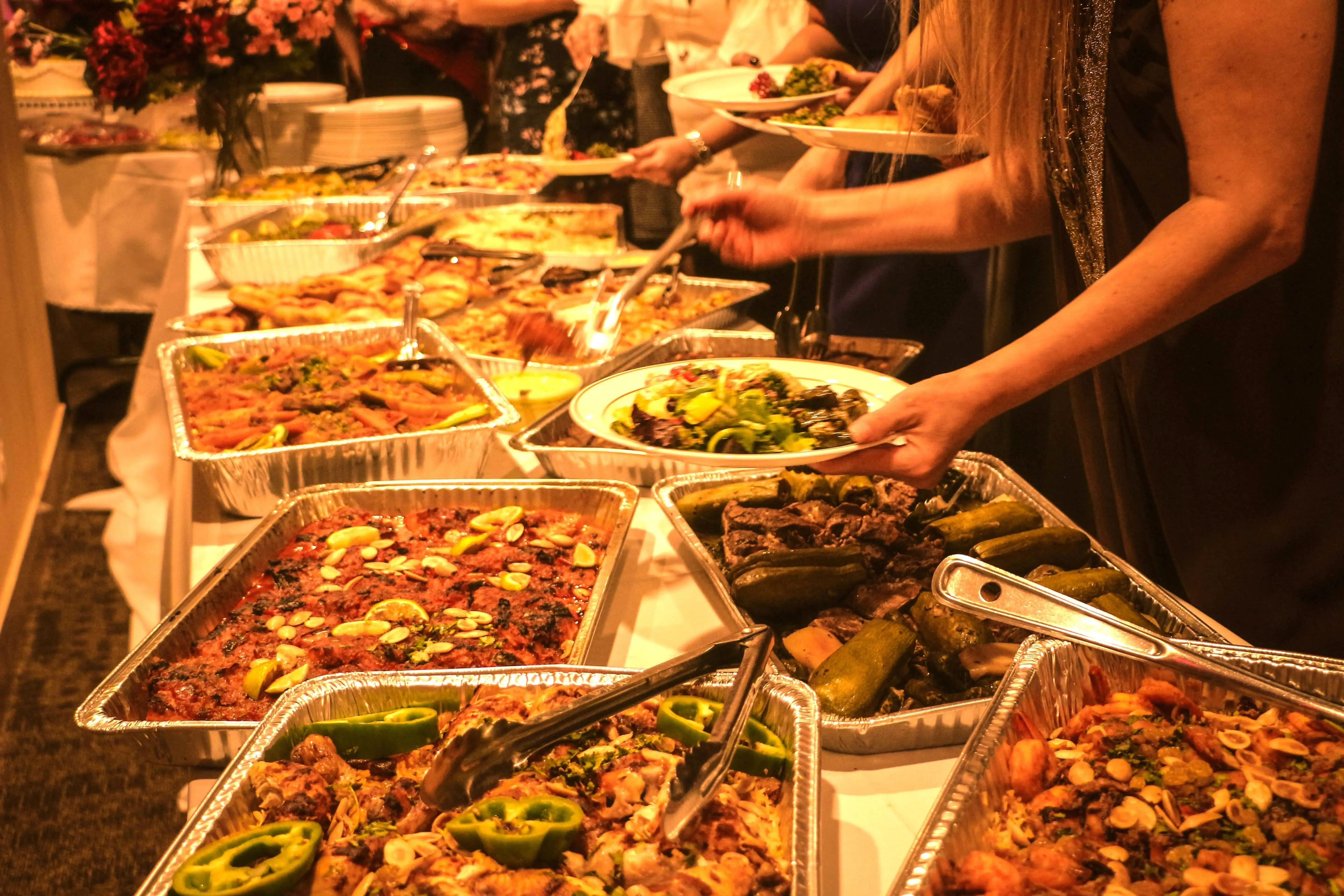
Party trays are the right call for a team event when the group is between roughly 10 and 60 people, the food goes out in one wave, and nobody wants to manage a staffed buffet line. Thai party trays in Toronto from Evergreen Thai Kitchen & Bar arrive as shareable trays that a team lays out in a few minutes: lift the lids, set out serving spoons, done.
Trays fit best for:
- lunch-and-learns and department lunches
- executive or client meetings where the food sits on a side table
- team socials and smaller appreciation events
- workshop or training days with a fixed lunch break
- internal celebrations, from a project wrap to a colleague’s send-off
Party trays are shareable, self-serve trays of one dish each, sized for a group and set out family style rather than plated or boxed. That definition points to the tradeoff. Trays give flexibility and variety at low coordination cost. They do not give per-person portion control, and above roughly 80 guests a buffet setup with more dishes and a longer service window usually works better. If you are choosing between trays, a buffet, and boxed meals, the Thai buffet catering guide walks through that decision by headcount.
Plan intent, logistics, and service flow before dish names
The most common tray-order mistake downtown is starting with the menu. Start with three questions instead, in this order.
Intent. What is the event for? An office lunch, a client meeting, a workshop, a team social, and an appreciation event each imply different tray priorities. A client meeting wants tidy, mild, easy-to-plate dishes. A team social wants abundance and something to talk about.
Logistics. Downtown Toronto buildings are not interchangeable. Within a few blocks of 175 Dundas St W, one tower routes couriers through a loading dock, the next wants concierge check-in, and a third lets the driver ride straight up to reception. Confirm early:
- exact address, floor, and suite
- receiver name and a backup phone number
- lobby, elevator, or loading dock process
- the delivery window that leaves time to set up before people arrive
Service flow. How will people actually eat? A seated meeting eats in one wave. A social with staggered arrivals grazes for an hour, so trays need to hold well and later arrivals still need food. Mixed dietary complexity and the time available for setup and cleanup both shape the lineup.
Most downtown “menu problems” are logistics problems in disguise: a great tray that reaches the boardroom 25 minutes late is a bad lunch. Settle intent and logistics first and dish selection becomes the easy part.
Build the tray lineup by role
A stable tray lineup gives every tray a job. For most team events, that means:
- One or two broad-appeal mains. Cashew Chicken, Chicken Satay, or Basil Stir Fry are the safe anchors. Pad Thai counts as a main if it is the only noodle on the table.
- One substantial vegetarian-friendly tray. Golden Tofu, Tofu Basil, or Mixed Vegetable Curry at real volume, not a token half tray.
- One rice or noodle base. Jasmine rice plus Pad See Ew or Vegetable Fried Rice gives plates a foundation and stretches the curries.
- One balancing side or freshness component. Mango Salad or Spring Rolls opens the meal and gives lighter eaters something to reach for.
This structure balances inclusivity with operational simplicity. Overly complex menus with eight small trays tend to underperform in a busy office: guests hover, the popular tray empties, and three others go home as leftovers. Four to five trays with clear roles almost always beats nine trays chosen for variety.
For a 20 person lunch-and-learn, a working example looks like Chicken Satay and Green Curry as mains, Tofu Basil as the vegetarian anchor, jasmine rice and Pad Thai as the base, and Spring Rolls to start. Swap Massaman Curry in for Green Curry when the group leans mild, and add Drunken Noodles when a few colleagues always ask for heat.
Vegetarian party trays that carry their weight
Vegetarian trays are for the whole table, not only for the vegetarians. In a mixed office group, most guests sample the vegetarian tray regardless of what they declared on the form, so its volume should reflect shared demand, not the declared vegetarian headcount. A 30 person team with 4 vegetarians still usually needs a full-size vegetarian main.
Choose vegetarian trays by role, the same way as the rest of the order:
- one or two substantial vegetarian mains, such as Mixed Vegetable Curry or Tofu Basil
- one familiar bridge dish everyone recognises, such as Vegetable Pad Thai
- one lighter balancing tray, such as Mango Salad
- a starch base if the event crosses the lunch peak, such as Vegetable Fried Rice
Office context also changes what performs. For meetings and training sessions, trays should serve quickly, hold up during a staggered eating window, and taste good to a broad range of palates. Delicate items look good at the counter but sag by the time the second wave of guests arrives; curries and stir fries hold.
Ingredient confidence is what gets a tray approved. Admins say yes faster when they know which trays contain egg, peanuts, or fish sauce. Thai curries at Evergreen use coconut milk rather than dairy, and vegan versions of noodle, curry, and rice dishes are available on request. Fish sauce and oyster sauce are in the kitchen, so state vegan requirements when ordering rather than assuming. The mixed dietary preferences guide covers how to size a half-vegetarian, half-chicken order.
How many trays, and how to keep the budget honest
Even a strong lineup fails when the quantity assumption is wrong. Size tray counts to real attendance, not the invitation list: a 40 person invite with a typical 75 percent show rate is a 30 person order, plus a small buffer for the colleagues who just want to try the curry.
A simple budget model maps spend to outcomes in three layers:
- Baseline coverage. Enough core mains and base for the appetite you expect. Fund this first.
- Resilience buffer. Room for attendance variance and crossover sampling, usually one extra main or base tray.
- Upgrade layer. Extra variety or a premium tray such as Crispy Calamari, added only after coverage is secured.
Four things inflate spend without improving the meal:
- too many low-volume dish types
- late headcount finalisation that forces over-ordering
- no attendance confidence range
- premium extras bought before core coverage
Treat budget and quantity as one decision. Decide the headcount range and the coverage you want, then let the tray count follow. For tray counts at 10, 20, 30, and 50 guests, use the guest count and budget catering guide before you finalise. If you run recurring team events, keep a note of the leftover rate by dish after each one; two or three data points make the next order noticeably tighter.
Make trays feel like an upgrade, not standard office food
Trays only feel like a treat if they taste different from the last meeting’s platter. The point of Thai trays for a team event is variety, heat, and aroma: a Panang Curry that fills the boardroom with lemongrass and coconut, satay with charred edges and peanut sauce, Drunken Noodles with a basil kick for the colleagues who ask for spice.
Three moves keep trays simple for the organizer and interesting for the team:
- Mix textures. Pair a saucy curry with a dry stir fry and something crisp such as Spring Rolls or Crispy Calamari.
- Offer one mild and one bold. Massaman Curry alongside Basil Stir Fry lets cautious and adventurous eaters both find a plate.
- Add one talking point. Pineapple Fried Rice or Mango Salad gives the table a dish people remember.
For appreciation events the same trays scale up with an extra starter and a bright finish such as Mango Salad served last. Evergreen Thai’s employee appreciation catering uses the same tray-role logic with a more generous ratio of starters to mains, because socials graze longer than lunches. Simple can still feel thoughtful: the win is a table that looks generous and takes the organizer five minutes to set.
Downtown delivery and handoff for tray orders
Tray orders succeed or fail at the handoff. Evergreen Thai delivers directly for group orders over CAD 200 within 5 km of 175 Dundas St W, which covers the Financial District, City Hall, the hospital row on University Ave, TMU, UofT, and King West. Inside that radius a shorter route means hotter curry and a more predictable arrival.
Give the kitchen the details that make the last 100 metres work:
- building name, floor, and suite, not only the street address
- whether the driver reports to security, concierge, or a loading dock
- the receiver’s mobile and a backup contact who will actually answer at 11:45
- the time you want food on the table, not the time you want the driver in the lobby
- where trays will sit: a cleared table, serving spoons, and plates ready
Downtown lunch traffic peaks between 11:45am and 1:00pm. Ask for the food 20 to 30 minutes before the meal starts so setup is unhurried. For orders serving 10 or more people, the group order page for downtown Toronto explains how the direct delivery option works, and the office catering checklist has the full delivery-notes template for towers and PATH-connected buildings. Pickup at 175 Dundas St W is a good option for smaller tray orders when a team member is already near St Patrick station.
Common mistakes and the pre-order checklist
Five mistakes cause most tray-order friction in downtown offices:
- Starting with dish names before confirming logistics.
- Under-sizing the vegetarian tray in a mixed group.
- Ignoring staggered arrivals, so latecomers find empty trays.
- Treating budget and quantity as separate decisions.
- Not assigning one owner for handoff communication.
Each one creates avoidable friction that can overshadow good food. Before you place the order, confirm all six:
- final headcount range confirmed
- dietary notes gathered into one message
- delivery address, receiver, and backup contact validated
- service window aligned with the agenda
- tray count checked against a quantity benchmark
- an internal contact reachable at delivery time
When all six are clear, the order runs on rails, and the organizer spends the event with the team instead of on the phone with the lobby.
Why Evergreen Thai for downtown team trays
Evergreen Thai Kitchen & Bar has cooked for downtown Toronto teams from 175 Dundas St W, near University Ave, since 2007. Nineteen years of office lunches, boardroom trays, and appreciation socials means the kitchen already knows the towers, the lunch windows, and the mixed-diet ratios that make a tray order work. Trays are packed for a comfortable range of 10 to 500+ guests; for anything in the 500 to 1,000 range, contact the kitchen early to confirm capacity and timing.
The kitchen is open Monday to Saturday 11am to 9pm and Sunday 3pm to 9pm, so evening socials and weekend team events are covered as well as weekday lunches. Vegetarian, vegan, dairy-free, gluten-aware, and no-onion-no-garlic versions are available on request; confirm them when ordering.
To start, send your headcount range, event time, building details, dietary mix, and budget to get a catering quote, or call +1 416-581-8668 and the team will suggest a tray lineup that fits your event.