
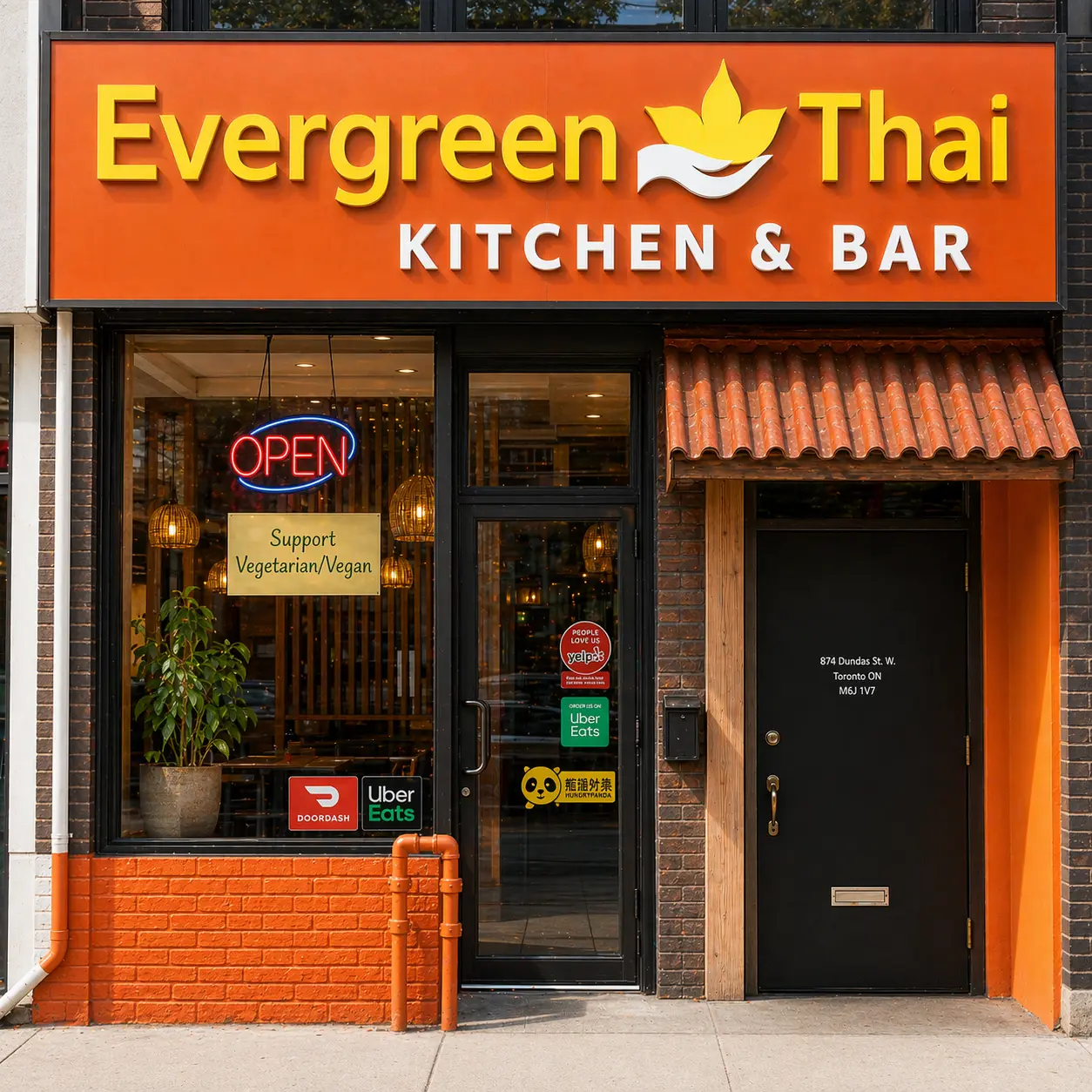
Start with a website that sells catering, not only the menu
A restaurant website earns its keep when it answers a catering buyer in under a minute: what do you serve, how much, how fast, and how do I order. For Evergreen Thai that meant giving the website to Plansale, a Toronto digital marketing and business systems company in North York that designs websites, service pages and landing pages and treats local SEO and tracking as part of the same job. A restaurant website in Toronto is a lead-generation tool first and a brochure second.
The practical result is a site organised around the questions a downtown office manager actually asks. There is a service page for corporate catering in Toronto, one for office catering and one for party trays, each with its own prices, tray sizes and FAQs rather than one long page for everything. A visitor who needs lunch for 20 on Thursday should land on the page written for that.
Three design choices mattered most:
- One page per intent. Corporate, office, party trays and buffet each have their own page, so search results and AI assistants can match a question to the right answer.
- A single, repeated next step. Every catering page ends on the same quote request, so there is never a dead end.
- Measurement built in. Calls, emails, button clicks and form submissions are tracked so we can see which pages produce orders.
If you are planning the same kind of rebuild, a useful rule is to write the page list from your customers’ questions before anyone opens a design tool.
Let a planner do the first draft of the order
The biggest change for catering customers is that they no longer wait for a quote to see a menu. ScaleUp, a Toronto marketing agency that builds secure forms, online booking and lead-attribution systems, built the catering planner, the forms and the AI analysis behind it. A catering planner is an online form that turns a date, a headcount, a budget and dietary needs into a complete menu with a tax-included price in seconds.
Our recommended menus are built from nearly 20 years of downtown Toronto group orders, analysed with AI. The analysis looks at what teams reorder, how much food a group really eats and which mixes keep meat-eaters and vegetarians at the same table. The planner then applies that to your event, so a 30-person lunch and a 150-person conference do not get the same answer. The customer can swap a dish, change a tray from small to large, add drinks and send the order, and the kitchen receives it already priced.
The forms do a second job that guests never see. Each request records where the visitor came from, whether Google search, a map listing, social media or an AI assistant, plus what they asked for. That tells us which channels bring catering inquiries rather than casual browsing. It is the same attribution discipline ScaleUp applies to booking forms elsewhere, adapted to a kitchen.
What we would tell another restaurant owner:
- Collect fewer fields, but the right ones. Date, headcount, dietary needs, spice level and budget give a planner enough to work with.
- Say plainly what is automated. The planner recommends and prices; a person at the restaurant still confirms every order.
- Keep allergy handling human. The form flags peanuts, egg and seafood requests, and severe allergies are confirmed by phone.
To see it work, open the catering quote planner and try a few headcounts.
Make the brand physical with a logo and signs that match the screen
A restaurant is judged first from the sidewalk, so the logo and the signs got the same attention as the website. Elite Fixtures designed the Evergreen Thai logo and the signs and then manufactured the signs. Elite Fixtures is a custom fixture and commercial millwork maker with an office in Markham, Ontario, a factory in Huizhou, China, and more than 25 years of experience in store and restaurant fit-outs, which is why design and production could stay with one team.
The reason to keep design and manufacturing together is that a sign is a manufactured object, not a picture. Materials, lighting, letter depth and mounting all decide whether the artwork you approved on screen looks the same at night on Dundas Street. A designer who also controls the factory can adjust the drawing to what the material can do, instead of handing over a file and hoping.
A short checklist for restaurant signage in Toronto:
- Read it from across the street. Test the logo at the distance a pedestrian actually sees it, not on a monitor.
- Plan the lighting. A sign that looks right at noon may disappear after dark.
- Match the digital version. The sign, the website header and the delivery bag should use the same logo, colours and spelling of the name.
- Ask who installs and who services it. A beautiful sign still needs a plan for repairs.
Our neighbour VegeDelight, the fully vegetarian restaurant at 173 Dundas St W, is also an Elite Fixtures client, which made it easy to keep the two storefronts looking like a coordinated pair.
Treat bags and printed menus as part of the order
Catering and delivery are the moments a customer holds your brand in their hands. Elite Fixtures designed the Evergreen Thai bags and produced the bags and the printed menus, so what arrives at a boardroom door matches what the customer saw on the website. A delivery bag is a small billboard that travels into offices, hospitals and campus buildings.
Packaging decisions have a practical side that is easy to underrate. A bag has to carry hot trays without tearing, keep the order together, and carry the logo clearly enough that a receptionist knows who sent it. A printed menu has to be legible in a stairwell, hold up to a coffee ring and show the allergy and halal information correctly. We list halal Thai food in downtown Toronto on the menu in plain words, and that wording has to survive printing unchanged.
If you are specifying packaging for a restaurant, decide these four things up front:
- Size and load. Weigh a full order before choosing handle and bag type.
- Print areas. Keep the logo, phone number and website where a hand will not cover them.
- Menu content. Lock prices, dietary notes and the halal statement before the first print run.
- Reorder path. Know how to reorder the same bag without a new setup.
Choose partners the way you would choose a kitchen team
The decision that made this rebuild work was splitting it by craft and keeping one owner on our side. Here is how the work was divided:
| Area | Team | What they own |
|---|---|---|
| Website and service pages | Plansale | Design, page structure, local SEO, tracking |
| Catering planner, forms, AI analysis | ScaleUp | Planner, secure forms, lead attribution, recommendations |
| Logo, signs, bags, printed menus | Elite Fixtures | Design and manufacturing of everything physical |
A restaurant that spreads this work across three teams without a brief ends up with three different looks. We avoided that with a few habits:
- One brief, one set of assets. The same logo files, colours, photos and menu wording went to all three teams.
- One person approves. Someone from the restaurant signed off every proof, so nothing was approved by committee.
- Start from the customer’s path. Search result, then page, then planner, then food arriving in an Evergreen bag.
- Test before launch. Run sample catering requests through the planner and check every total by hand.
For a restaurant under about 30 seats that serves mostly walk-in guests, the website and signage come first and the planner can wait. For a restaurant where catering is the growth goal, as it is for us, the planner earns its place early because it removes the slowest step in a catering sale: waiting for a quote.
What the rebuild changes for a catering customer
For someone ordering from downtown Toronto, the rebuild shows up in small ways. The menu and prices are easier to find. The planner gives a priced menu before you pick up the phone. The food arrives in a bag that looks like the website you ordered from. If you are working out tray counts, our guides on office catering planning, guest count and budget and corporate catering in downtown Toronto go into the detail, and our Thai restaurant page covers dining in at 175 Dundas St W.
We are a restaurant, not a design or technology firm, so the credit for the craft belongs to the three teams named above. What we contributed was the menu, nearly 20 years of customer orders, and a clear idea of how a catering customer wants to buy. Ingredient clarity matters just as much as design, so our ingredient transparency guide explains what to ask any caterer before you order.
Ready to try the planner?
Tell us your date, headcount, dietary needs and spice level, and the planner builds a menu you can adjust and send. Get a catering quote online, or call +1 416-581-8668 and we will walk through it with you.