Start with the downtown lunch window, headcount, and delivery path
Downtown office lunch catering is an operations problem before it is a menu problem. The lunch window in most downtown Toronto offices runs from about 11:45 a.m. to 1:00 p.m., and a 15-minute delay can wipe out the eating time between two meetings. Before anyone debates dishes, lock the three details that decide whether food arrives hot and on time.
- Room-ready time, not delivery time. Food needs to be on the table, opened, and labelled when the team walks in.
- Headcount range, even as an estimate. Attendance on office days varies, so plan a range and confirm the final number 24 hours out.
- The path into the building: lobby security, concierge handoff, elevator wait, loading access, and who meets the driver.
This is where office catering in Toronto from a kitchen inside the core makes a practical difference. Evergreen Thai Kitchen & Bar sits at 175 Dundas St W, steps from St Patrick station, City Hall, and the Eaton Centre, and within a short drive of the Financial District towers, PATH-connected buildings, TMU, UofT, and the hospital row on University Ave. Shorter routes mean tighter timing and food that arrives closer to the temperature it left the wok.
For everyday orders that do not need coordination, Thai lunch delivery for downtown Toronto offices covers the simple case. Once the meal serves a whole team rather than a few desks, the rest of this guide applies.
Choose a format that keeps the meeting on schedule
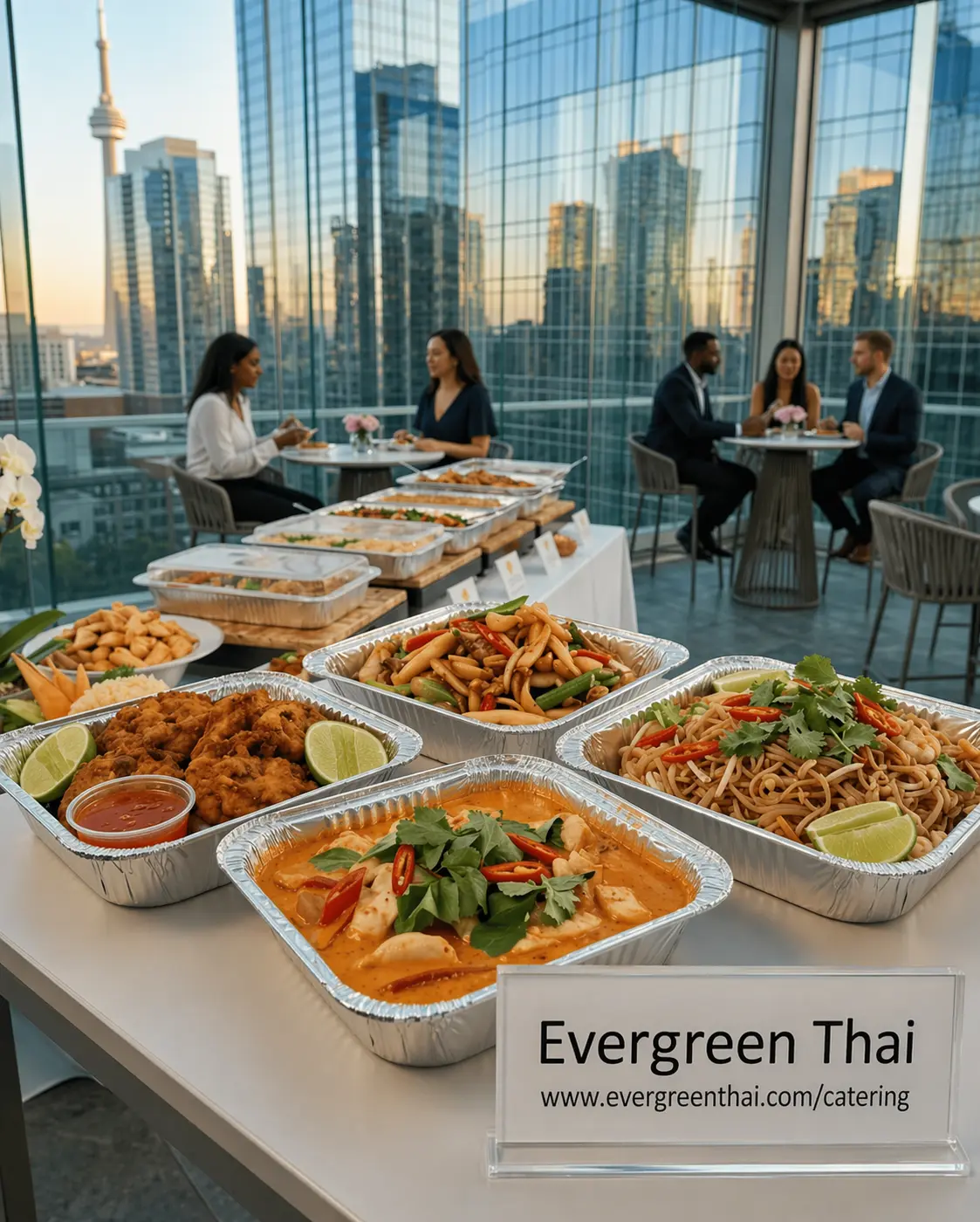
Party trays are the right default for most office meeting lunches, and the reason is speed. Meeting catering is not party catering. The food has to arrive on time, set up in minutes, and be served without pausing the agenda. Shared trays do that better than any other format for groups under about 40.
Match the format to the room and the clock:
- Shared trays for boardroom lunches, team meetings, and lunch-and-learns. Clean setup, easy self-serve, minimal packaging to clear.
- Buffet-style setup for larger training days or all-team sessions where people eat in waves. See the full breakdown in the guide to Thai party trays for downtown team events.
- Boxed or individual meals, available on request, for sessions where people eat at their desks or leave with lunch in hand.
- A hybrid: individual mains for clarity plus a few shared starters for variety. This suits social team lunches that still need clean distribution.
Whatever the format, the food should be easy to hand out, easy to recognize, and easy to eat in a short break. Fragmented orders with a dozen one-off items slow everything down the moment the delivery lands. A cleaner menu structure helps the organizer as much as the diners.
What to order for a team lunch: build around familiar favourites
The safest team lunch is not the blandest one. It is the order that gives people enough familiarity, enough choice, and enough balance that the organizer never has to apologize for the menu. For downtown teams, recognizable dishes outperform niche picks because people choose quickly and eat without decoding anything.
Build the order in layers:
- Lead with dishes most people recognize: Pad Thai, Pad See Ew, Green Curry or Red Curry with jasmine rice, Cashew Chicken.
- Add one or two lighter options: Mango Salad, Tom Yum or Tom Kha soup, Vegetable Fried Rice.
- Make the vegetarian option visible, not an afterthought: Tofu Basil, Mixed Vegetable Curry, or Vegetable Pad Thai as a real tray, not a garnish.
- Use starters to round out the meal: Spring Rolls, Golden Tofu, Chicken Satay, Crispy Calamari.
Thai food works for mixed office teams because noodles, rice dishes, curries, and vegetable plates can all come from one kitchen and one order. Evergreen Thai curries use coconut milk rather than dairy, and vegetarian or vegan versions of noodle, curry, and rice dishes are available on request. Fish sauce and oyster sauce are in the kitchen, so state vegan or no-onion-no-garlic needs when ordering rather than assuming. For teams that split between vegetarians and meat eaters, the guide to Thai catering for mixed dietary preferences walks through the ordering ratios.
How much to order for 10, 20, or 30 people
Plan by tray role, not by dish name. Every office lunch order needs a main, a vegetarian anchor, a base, and a side. Scale those roles up with the headcount and the order stays balanced without guesswork.
For 10 people, keep it focused:
- one broad-appeal main such as Pad Thai or Cashew Chicken
- one vegetarian-friendly dish such as Tofu Basil
- a rice or noodle base
- one appetizer or side
For 20 people, add variety so no single dish has to please everyone:
- two mains, for example Green Curry and Basil Stir Fry
- one substantial vegetarian tray
- one rice or noodle base, or both
- Spring Rolls or another shared appetizer
- clear serving notes and labels
For 30 people, plan the table more deliberately:
- multiple main trays so nothing runs out early
- vegetarian coverage with real volume, not a token portion
- jasmine rice and a noodle tray
- appetizers that reduce line pressure while mains are opened
- labels if dietary needs are mixed
At 30 and above, one missing detail creates real friction: a second serving spoon, a table that was never cleared, or a floor number left off the order. For larger groups, tray counts by headcount, and budget bands, the guest count and budget catering guide has the full planning tables.
Best hot dishes for downtown office meetings
Hot food is the clearest difference between a generic office lunch and a meal the team looks forward to. Restaurant-made hot dishes improve perceived quality, appetite coverage across preferences, energy in long sessions, and willingness to join recurring lunch programs. Cold boxed sandwiches rarely do any of that.
The best hot meeting dishes are practical to serve, stable in a tray for 30 to 45 minutes, and broad enough for a mixed office. From the Evergreen Thai menu, these hold up best:
- Pad Thai and Pad See Ew: familiar, portion cleanly, keep texture in a covered tray.
- Green Curry, Red Curry, Panang Curry, Massaman Curry with jasmine rice: coconut-based, stay hot longest, and stretch across headcount.
- Basil Stir Fry and Cashew Chicken: rice-friendly mains with broad appeal.
- Pineapple Fried Rice and Vegetable Fried Rice: double as a base and a main.
- Tofu Basil and Mixed Vegetable Curry: vegetarian anchors with the same heat and heft as the meat trays.
- Drunken Noodles for teams that like more spice; keep milder dishes alongside.
The goal is not to replace every lunch with one cuisine. It is to match the format to the context, and when a team wants more than cold boxed lunches or repetitive sandwiches, hot tray service wins. The reasons are laid out in why hot food matters for downtown office lunches, and the direct comparison in Thai catering vs sandwich catering covers cost per person and leftovers.
Weekly and monthly lunch programs: rotate without rebuilding
Recurring office lunches work best when the menu rotates but the planning does not. A weekly Thursday lunch or a monthly all-team meal should never be rebuilt from scratch. Set a repeatable baseline and swap one or two components each cycle.
A four-week cadence that keeps participation high:
- Week 1: noodle-forward. Pad Thai, Pad See Ew, Vegetable Pad Thai, Spring Rolls.
- Week 2: rice and curry. Green Curry, Massaman Curry, Mixed Vegetable Curry, jasmine rice.
- Week 3: stir-fry and lighter sides. Basil Stir Fry, Cashew Chicken, Tofu Basil, Mango Salad.
- Week 4: team favourites with one seasonal swap. Repeat the two dishes people asked about, add one new item.
For a monthly program, use the same four templates across four months and shift the starters. Menu rotation should balance three things: familiarity so people keep showing up, dietary coverage so the vegetarian anchor never disappears, and prep efficiency so the kitchen can build the order the same way each time.
What stays fixed between cycles is the operational file: headcount range, delivery notes, room-ready time, contact phones, and standing dietary notes. Once those are on record with the kitchen, reordering is a two-line message. Ask the kitchen to keep a standing note on the account so a change in headcount is the only variable each week.
Return-to-office days and hybrid anchor days
Hybrid schedules make in-office lunch days more intentional, so the lunch has to be worth coming in for. On an anchor day the whole team is in the building at once, attendance is higher than an average weekday, and the eating window often sits between a morning session and an afternoon block. That raises the bar on both food quality and timing.
Plan return-to-office lunches as part of the team rhythm rather than an afterthought:
- Prioritize mixed preferences. Anchor days pull in everyone, including the vegetarian, the spice-averse, and the person who only eats rice dishes. Use one substantial vegetarian anchor plus complementary non-vegetarian trays with clear ingredient notes.
- Plan for a faster reset. Trays that open, serve, and clear in minutes let the room flip back to work mode without a cleanup crew.
- Confirm the headcount the day before. Hybrid attendance moves. Ask for RSVPs on the office calendar and give the kitchen a final number 24 hours out.
- Fix the room-ready time, not the delivery time. If the session breaks at 12:15, food should be on the table at 12:05.
For tower offices, include exact building and suite details, not just the street address. In large downtown buildings, delay comes from handoff ambiguity far more often than from kitchen timing. Building name, company name and floor, primary and backup contact, preferred handoff point (lobby, concierge, or reception), and target in-room time are the five fields that make hybrid-day orders repeatable. Tray-based formats for 10 to 50 guests suit these days without needing an event-style setup.
Busy seasons and winter: tax season, audit weeks, and cold-weather lunches
Peak workload weeks and cold months are the two moments when a hot office lunch does the most work, and both reward a repeatable system over one-off ordering.
Tax season, audit season, and crunch weeks
Accounting, legal, and finance teams across the Financial District and University Ave run long days from February through April, at quarter-end, and during audit fieldwork. Lunch in those weeks is fuel and morale, not an event. Set up the order once at the start of the season and repeat it:
- Fix a standing weekly slot (for example, Tuesday and Thursday at 12:00) so nobody has to decide on the day.
- Order for the desk, not the boardroom. Hot trays with jasmine rice and a curry or stir-fry hold well while people eat in shifts.
- Keep one vegetarian tray and one milder dish in every order so late additions to the team are covered.
- Consider a second evening drop for teams working past 7 p.m.; the kitchen is open until 9 p.m. Monday to Saturday.
Winter comfort dishes for downtown offices
Cold-weather office lunches perform better with hot, substantial food and delivery routes that stay short. A tray that leaves a kitchen 15 minutes away in January arrives hotter than one driving in from the suburbs, and the dishes should be chosen to hold heat:
- Tom Yum or Tom Kha soup in a shared tray as a first course
- Massaman Curry and Panang Curry, the richest, slowest-cooling curries on the menu
- Drunken Noodles and Basil Stir Fry for warmth and spice
- Pineapple Fried Rice as a hearty base
Keep lids on until the room is ready and set trays away from a draft. Winter is also when lobby handoff matters most: a driver waiting at a security desk is time the food is losing heat, so confirm who is meeting the delivery.
A reusable planning flow for managers, EAs, and HR teams
Use one standard planning flow for every office lunch and adjust one variable by role. Office managers usually optimize for budget and speed, executive assistants for timing precision and meeting readiness, and HR or people-ops teams for inclusivity and participation. The template stays the same; the emphasis changes.
The flow that prevents most downtown failures:
- Confirm the headcount range and attendance risk.
- Consolidate all dietary notes into one message.
- Decide the service format: shared trays, mixed setup, or boxed add-ons.
- Validate building details: entrance, floor, handoff contact, backup phone.
- Confirm the room-ready time and the setup surface.
- Keep one owner responsible for day-of communication.
Then match the emphasis to the scenario: a boardroom lunch needs an exact room-ready time and a clean shared setup, a team workshop needs easy self-serve flow and stable portions, and a campus or condo event needs handoff clarity and practical tray formats. The full field-by-field version lives in the office catering checklist for downtown Toronto office managers.
After each order, capture a two-minute debrief: was the room ready on time, did the dietary mix fit, what was the leftovers ratio against attendance, and any comments on labelling and serving flow. That record turns a one-off lunch into a program the team trusts.
Small lunches can stay in a normal order flow. Once the meal serves 10 or more people, needs a specific room-ready time, or involves building access and dietary coordination, use the quote path instead. Direct group delivery from Evergreen Thai Kitchen & Bar applies to orders over CAD 200 within 5 km of 175 Dundas St W, which reaches most of the downtown core. Send headcount, date, timing, building details, and dietary notes to get a catering quote, or call +1 416-581-8668 to talk it through with the kitchen.