Why Pad Thai is the anchor dish for Toronto group orders
Pad Thai works as a catering anchor because it is the one Thai dish almost every guest recognises, and recognition is what keeps a shared table moving. For party trays in Toronto, an anchor dish is the tray that people reach for first and that sets expectations for everything beside it. Curries need explaining to some guests; Pad Thai does not.
It also has practical advantages that show up on delivery day:
- One tray feeds many: stir-fried rice noodles are dense, so a single tray covers more plates than a salad or an appetizer of the same footprint.
- It suits every occasion: office lunches, boardroom meetings, campus club events, condo party rooms and birthday gatherings all order it.
- It bridges diets: chicken, tofu and vegetable versions come from the same base, so a mixed team can share one dish across several trays.
- It travels: covered and kept warm, it holds up for the short run from 175 Dundas St W to any downtown tower.
Evergreen Thai Kitchen & Bar has been making Pad Thai for group orders since 2007, and it appears on more catering tickets than any other single dish. That familiarity is worth something: when a team has never ordered Thai catering before, Pad Thai is what makes the first order feel safe.
Chicken, tofu and vegetable versions compared
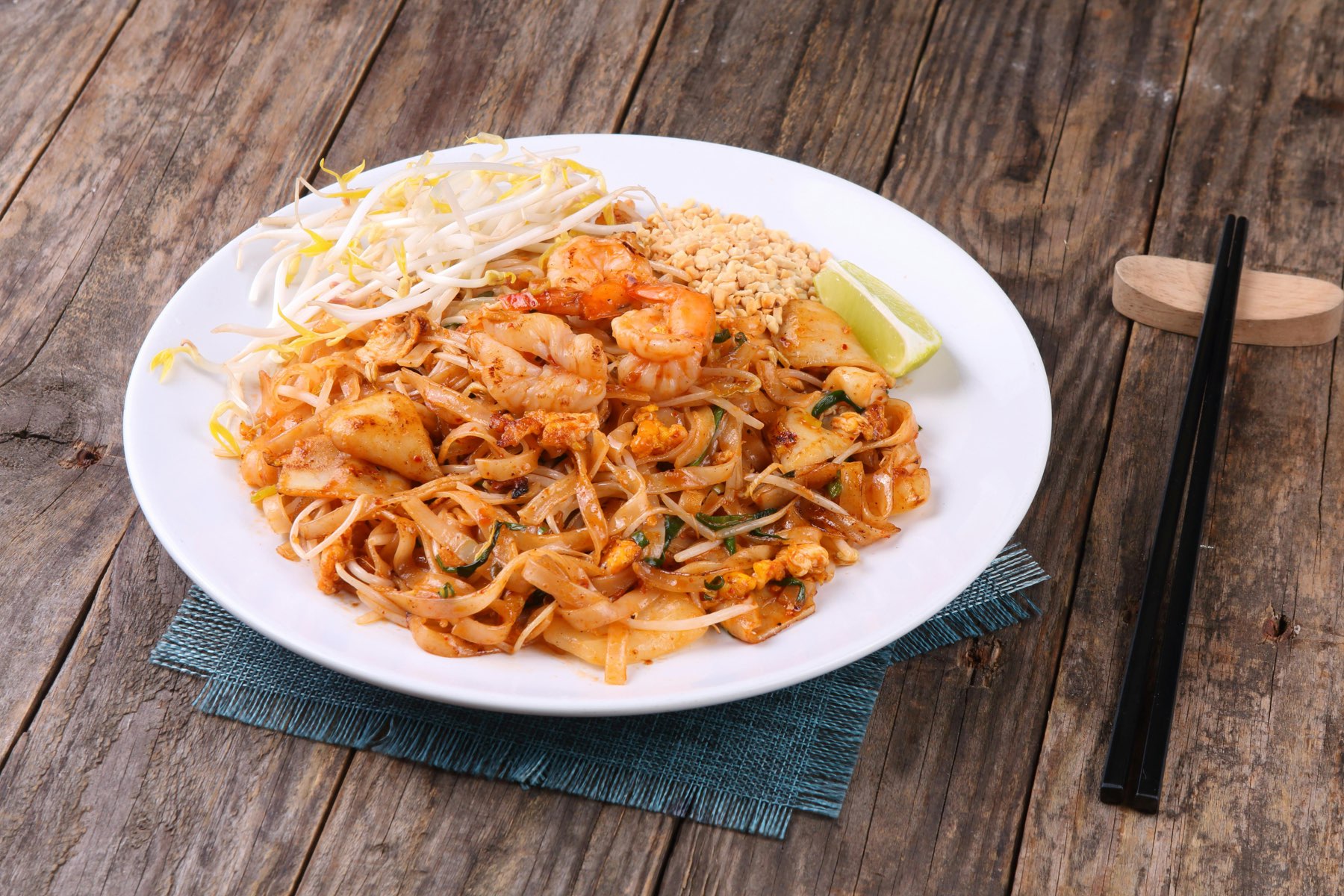
Order at least two versions of Pad Thai for any group above 15 people, because the protein choice is where a single tray stops being universal. The base is the same in all three: flat rice noodles stir-fried with tamarind sauce, egg, bean sprouts, garlic chives and crushed peanuts.
- Chicken Pad Thai is the default for most offices and the version that meat-eating colleagues expect. It is the one to size largest in a mixed group.
- Tofu Pad Thai uses firm tofu that takes on the sauce well and stays pleasant at room temperature. It is the strongest choice for vegetarian guests who want protein rather than just vegetables.
- Vegetable Pad Thai leans on bean sprouts, carrot, cabbage and chives. It is lighter, popular with guests who want a smaller portion, and the natural base for a vegan tray.
For a 20-person mixed team, one chicken tray and one tofu or vegetable tray is the usual split. Vegetarian trays get eaten by everyone, so size them for crossover, not for the declared vegetarian count alone. Both meat-free versions also sit comfortably on the list of vegetarian catering ideas that are not just salad, which is useful when a team is tired of the token green tray.
Vegan, egg-free and dairy-free requests
Vegan Pad Thai must be requested at order time, because standard Pad Thai contains both egg and fish sauce. The kitchen prepares egg-free and fish-sauce-free versions on request, using soy-based seasoning in place of fish sauce, but it cannot retrofit a tray that was cooked the standard way. Say “vegan, no egg, no fish sauce” when ordering and the tray will be built and labelled accordingly.
Three related requests are worth separating, because they are not the same thing:
- Egg-free removes the scrambled egg but may keep fish sauce. This suits egg allergies and some vegetarian guests.
- Vegan removes egg and fish sauce, and the kitchen checks that oyster sauce is not used in the tray either. Fish sauce and oyster sauce are used daily in the kitchen, so the vegan request has to be explicit.
- Nut-aware means crushed peanuts served on the side rather than tossed through. The kitchen cannot certify any dish nut-free, so say so when ordering and the peanuts will be held back.
Dairy is the easy one. Pad Thai is dairy-free by construction: there is no butter, cream, milk or cheese anywhere in the recipe, and the richness comes from the tamarind and palm sugar sauce, not from dairy. For teams with lactose-intolerant members, that makes it a tray that needs no modification, and the guide to dairy-free Thai catering in downtown Toronto shows how the rest of the menu lines up the same way.
Rice noodles are also wheat-free and the tamarind sauce does not rely on soy sauce, which puts Pad Thai on most gluten-aware lists. Confirm the sauce with the kitchen when ordering; it is prepared with care on request, not certified.
How many Pad Thai trays per 10, 20, 30 or 50 guests
As a planning rule, count one Pad Thai tray per 10 guests when it is one of two starches beside jasmine rice, and move up a size if it is the only carbohydrate on the table. Tray sizes vary by dish and kitchen, so give the headcount when ordering and let the kitchen convert it; the ranges below are for planning the shape of the order.
- 10 guests: 1 medium tray of Pad Thai, plus rice, one curry, one appetizer. Choose one version, or split into two small trays for a mixed group.
- 20 guests: 2 medium trays or 1 large, ideally 1 chicken and 1 tofu or vegetable. Two starches (Pad Thai plus rice), two or three mains and Spring Rolls.
- 30 guests: 2 large trays. Keep the two-version split and add a third main so the table does not lean entirely on the noodles.
- 50 guests: 3 large trays, with the chicken tray sized largest. Above this size a buffet line and staged service start to make more sense than a single tray drop.
Total food volume is the real constraint: about 1.25 to 1.5 lb of food per person across all trays, with Pad Thai taking roughly a third of that when it is the anchor. The guest count and budget catering guide for downtown Toronto walks through the full tray counts and the CAD 300, 500 and 800 planning bands. Use it to size the whole order, not just the noodles.
Two adjustments from experience. Dinner events and after-work socials eat more Pad Thai than a one-hour working lunch, so use the top of each range for evenings. And if the group skews toward guests who rarely eat Thai food, Pad Thai will be the most-taken dish, so size it up and the curry down.
What to pair with Pad Thai
Pad Thai should never be the only dish, because a noodle tray on its own reads as takeout, not catering. The strongest group orders pair it with a rice base, a coconut-milk curry, one vegetarian main and a starter, so guests build a plate with contrast in texture and heat.
The pairings that work best:
- Spring Rolls: the crisp starter that goes before the noodles and disappears fastest. One small tray per 10 to 15 guests.
- Green Curry: the rich, slightly hot counterpoint to Pad Thai’s sweet and sour profile. Massaman or Panang Curry suit teams that prefer mild.
- Pineapple Fried Rice: a celebratory swap for plain jasmine rice at birthdays and team socials, and a second starch that is not another noodle.
- Tofu Basil: a savoury, herb-forward vegetarian main that gives plant-based guests something besides their own Pad Thai.
- Mango Salad: fresh and sharp, useful in summer or when the rest of the table is rich.
A curry is the single most valuable pairing, because it changes the table from “noodles and sides” to “a meal with a main”. The Thai curry catering guide for Toronto compares Green, Red, Massaman and Panang for group orders and explains how much rice each one needs. Chicken Satay and Crispy Calamari are popular extras when the budget allows, though both are better at a social than at a working lunch.
Holding heat, re-tossing and serving
Pad Thai holds heat well for the first hour and then needs a quick toss to bring the texture back. Rice noodles absorb sauce as they sit and can clump at the edges of a tray, so the serving routine matters more for Pad Thai than for a curry.
For a downtown delivery, the practical steps are:
- Keep trays covered from the loading dock to the table. Lids off early is the main reason noodles dry out.
- Toss before serving. Two minutes with tongs redistributes the sauce, loosens clumps and makes the tray look freshly plated.
- Garnishes on the side. Ask for lime wedges, bean sprouts and crushed peanuts in separate containers; they stay bright instead of softening under a lid.
- Serve within 60 to 90 minutes of delivery. Beyond that the dish is still fine to eat, but the texture is past its best.
- Rice beside it, not under it. Guests who pile Pad Thai over rice end up with a heavy plate; keep the two starches side by side.
Delivery distance does most of the work here. Orders leaving 175 Dundas St W reach the Financial District, hospital row, City Hall and both downtown campuses in minutes, so trays arrive hot rather than lukewarm. Direct group delivery is included for orders over CAD 200 within 5 km of the restaurant; pickup is available for smaller orders, and for a team lunch of 10 or more, the catering path sets tray sizes and timing properly.
Common Pad Thai catering mistakes
The most common mistake is ordering only Pad Thai for a group and calling it catering. The second is ordering one version of it for 30 people with three different diets in the room. Both are cheap to avoid.
- Only noodles: a table of Pad Thai and nothing else leaves guests without contrast, rice-preferring colleagues without a base, and the noodles doing all the work. Add a curry and rice at minimum.
- One version for everyone: vegetarian guests should not be picking chicken out of their noodles. Order two versions above 15 guests.
- Assuming vegetable means vegan: standard vegetable Pad Thai still has egg and fish sauce. State vegan at order time.
- Sizing for the vegetarian count only: the tofu tray will be eaten by everyone, so size it for crossover.
- Late delivery windows: noodles suffer more than curries from sitting. Ask for the food 15 minutes before the meal, not 45.
- Forgetting the peanuts question: if anyone in the room has a nut allergy, ask for peanuts on the side and say so when ordering.
- Skipping the label: every tray needs a label with the protein and any vegan or egg-free note, or the team will ask the organizer 20 times.
The guide to Thai party trays for downtown Toronto team events covers how to structure the rest of the order once the anchor is set.
Order Pad Thai catering for your Toronto group
Pad Thai catering in Toronto works best as the familiar anchor of a balanced tray order: two versions for a mixed team, a coconut curry and rice beside it, garnishes on the side, and a toss with tongs before the group sits down. Get that structure right and the dish that everyone recognises becomes the dish that makes the whole lunch feel planned.
See the full list of noodle, curry and rice dishes on the Evergreen Thai menu, then send the headcount, timing and dietary notes. To start, get a catering quote or call +1 416-581-8668 and the kitchen will size the trays for your group.